http://inkweaver-review.blogspot.com/2009/04/snow-falling-in-spring-moying-li.html
“Snow Falling in Spring,” is a historical biography by Moying Li, about her life growing up during the tumultuous Chinese Cultural Revolution.
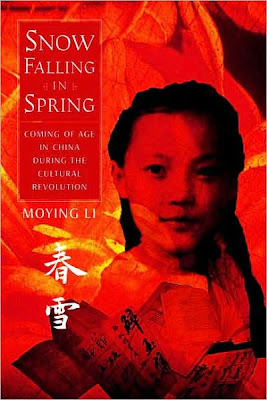
Moying Li begins her book with a description of her innocent childhood before the Cultural Revolution, playing in the courtyard of her family home with her friends and the family pets. Then she describes the beginning of the Cultural Revolution and its first manifestation in her childhood world: a large furnace for producing iron and steel. This furnace was erected in the courtyard where she liked to play.
During the Cultural Revolution the Chinese government announced that China could catch up to Western countries in one Great Leap Forward, if every citizen worked hard to increase the output of goods, food, etc. The Chinese eagerly embraced this bold plan. Moying Li describes how her initial apprehension about the steel furnace turned into wholehearted approval. She even went to the kitchen to pull out pots and pans to melt in the furnace. Despite the energy and enthusiasm put into the furnace project, though, the result is failure:
In the courtyard, Da Jiu and our neighbors sat on the woodpile, their heads bowed like those of defeated soldiers. The fire in the furnace had died, leaving a lingering smell of burned wood.
“What happened, Da Jiu?”
“The iron and steel we made was not good enough.” He sighed. I stared at him in disbelief. “We simply did not know enough to make it right,” he added.
Now I was sad, too. Climbing up the woodpile to sit next to him, I leaned my head against his shoulder, as crestfallen as he and our neighbors.
“But we tried so hard.”
“Yes,” he said. “We did.”
The failure of the furnace sets the tone for much of the rest of “Snow Falling in Spring.” Although the Cultural Revolution had grand goals, carrying out the plans was more difficult than it seemed and often had unanticipated results. For example, Moying Li mentions another government plan: to eliminate the sparrow. The idea was that this small bird ate seeds and crops, so by killing off the species in China food production would be boosted. Although the war against sparrows was highly successful and millions were killed, the next year saw crop failure as insects that would have normally been kept in check by the sparrows ravaged the fields.
Perhaps the most memorable statement in “Snow Falling in Spring” is found at the beginning of the fourth chapter.
Most people cannot remember when their childhood ended. I, on the other hand, have a crystal clear memory of the moment. It happened one night, in the summer of 1966, when my elementary school headmaster hanged himself.
Moying Li starts by describing her early days in school. She paints a vivid picture of caring, fun loving, teachers and interesting assignments that kept her busy and happy. But the atmosphere in Moying Li's school changed when the Red Guard movement began to gain momentum. Basically the Red Guard was a vast student group that developed as a backlash movement in response to Western ideology being taught in Chinese schools. The Red Guard felt that much of the instruction in Chinese schools was really propaganda designed to corrupt Eastern minds and turn young students away from Communism, toward Democracy. Whether this was the case or not, the Red Guard made it their job to expose school officials that they felt were not showing enough support for the Communist government.

Moying Li does an excellent job of showing the steps that led the Red Guard from watchdog status to full fledged militant terrorism. Then she shows how Red Guard violence touched people progressively closer to her, first her favorite teachers, then the school headmaster, and finally her own family.
While reading “Snow Falling in Spring” I felt that Moying Li has a very balanced approach in her discussion of the Cultural Revolution. Although she depicts the Red Guard as a violent group to be feared, she also shows how the people who were part of it were not necessarily evil. Moying Li and her family put forth their best effort with the furnace because they were eager to help their country. Likewise, the people who were part of the Red Guard were swept along by a spirit of nationalism and love of country. In one passage Moying Li is talking with a girl who was part of the Red Guard.
“I know how Lan must have felt,” Lee said, avoiding my eyes, “with her blood rushing and her heart pounding fast. At the time I did believe that our headmaster was an enemy of the people and that by teaching him a lesson we were defending Chairman Mao.”
After a long pause, Lee continued, lowering her head. “Now, after living here on this desolate mountain for so long, I'm not sure of anything.”
During the Chinese cultural revolution everyone was eager to do their best, eager to help the country. But one of the main messages of “Snow Falling in Spring” is, I think, that good intentions don't mean that you are doing the right thing. Just like the furnace attempt failed, and the sparrow extermination had negative results, likewise the Red Guard did damage to China rather than helping it. On the one hand the goal of the Great Leap Forward was to make China similar to Western countries. But how could the Chinese people learn to be like Western countries, unless they learned Western ways? The Red Guard wanted to protect the Chinese culture from being subdued by Western culture. In this respect they succeeded, but they also destroyed books and literature and killed and imprisoned the very ones that would have taught them the things they wanted to know.
“Snow Falling in Spring” is very well written. In addition to supplying historical facts, Moying Li explains the forces behind the Cultural Revolution from her firsthand viewpoint. The balanced historical elements of “Snow Falling in Spring” make it a book that I highly recommend for its educational and cultural value.
★★★★★

 Hart Evans has always been one of the coolest kids at his school. Even Hart's name itself is cool, so it is little wonder that coolness comes naturally for him. Hart's friendly attitude and pleasant nature make him everybody's friend. There is only one thing that Hart doesn't like, and that's chorus, organized by Mr. Meinert. Andrew Clements explains Hart's feelings with regard to chorus.
 Plot
Plot Characters


