
Book Review Blog Carnival #14
Other related posts:
Website Messages
The fourteenth edition of the Book Review Blog Carnival is being hosted at Book Thirty. Book Thirty is a high quality book review blog that did a great job hosting the carnival. Please stop by to see Inkweaver Review's own submission and other good reviews across the internet.

“Audrey, Wait!” by Robin Benway
Other related posts:
3 Star Books,
Modern Novels,
Realistic Fiction,
Young Adult Books
“Audrey, Wait!” by Robin Benway is a surprisingly masterful book about a teenage girl who suddenly becomes a famous figure.
 When Audrey decides to break up with her boyfriend Evan she feels that it is a justified thing. Not does Evan spend all of his time focusing on music and his band, but in the end they have little in common. Little does Audrey realize, however, but Evan is about to change her life completely. The night after Audrey leaves him Evan writes a song about the breakup, a song entitled “Audrey, Wait!”
When the song achieves minor success at a local band concert and on the local college radio station Audrey is slightly irritated, but she feels that the popularity will soon die out. But before she knows it “Audrey, Wait!” has leaped to the top of the charts and she has become a nationally recognized figure. People on the street know all about her breakup with Evan. Some people love her while others hate her. With the tabloids tracking her every move and the paparazzi storming her at home and at school Audrey feels that her life can never return to normal.
Robin Benway's “Audrey, Wait!” is a simply fantastic story. Not only does it show the real life behind being a star, but it shows how fame can influence people. “Audrey, Wait!” shows how the entertainment industry sucks people in, uses them to make money, and then spits them out without a second thought.
I recommend the fascinating “Audrey, Wait!” to all readers.
 When Audrey decides to break up with her boyfriend Evan she feels that it is a justified thing. Not does Evan spend all of his time focusing on music and his band, but in the end they have little in common. Little does Audrey realize, however, but Evan is about to change her life completely. The night after Audrey leaves him Evan writes a song about the breakup, a song entitled “Audrey, Wait!”
When the song achieves minor success at a local band concert and on the local college radio station Audrey is slightly irritated, but she feels that the popularity will soon die out. But before she knows it “Audrey, Wait!” has leaped to the top of the charts and she has become a nationally recognized figure. People on the street know all about her breakup with Evan. Some people love her while others hate her. With the tabloids tracking her every move and the paparazzi storming her at home and at school Audrey feels that her life can never return to normal.
Robin Benway's “Audrey, Wait!” is a simply fantastic story. Not only does it show the real life behind being a star, but it shows how fame can influence people. “Audrey, Wait!” shows how the entertainment industry sucks people in, uses them to make money, and then spits them out without a second thought.
I recommend the fascinating “Audrey, Wait!” to all readers.
 PlotCharacters
 PresentationOverall
“The Amazing Maurice and his Educated Rodents,” by Terry Pratchett
Other related posts:
5 Star Books,
Fantasy,
Young Adult Books
“The Amazing Maurice and his Educated Rodents,” by Terry Pratchett is an amusing rework of the Pied Piper legend.

Maurice is a tough alley cat who has survived in the dangerous streets for four years without getting hit by a cart or caught by dog gangs. An alley cat has to be smart to survive that long, so Maurice prides himself on being fairly clever. But the truth is that he's a lot smarter than most other cats. It all started one day when he looked into a puddle and realized that he was looking at his own reflection. When you can suddenly talk and think, its hard to hang out with the other dumb cats, so Maurice becomes friends with a group of rats who also happened to become clever about the same time Maurice did. Chances are it probably had something to do with the glowing garbage dump outside the wizard's academy, but Maurice can't be too sure about that.
Maurice doesn't worry to much about how he became clever. He immediately comes up with the ultimate money making scheme. Together with the intelligent rats and a young boy who knows how to play the flute Maurice creates the perfect Pied Piper scam. First they travel to an unsuspecting town, where the rats immediately begin wreaking havoc. Since they are so smart they can create the ultimate plague. They disarm traps and steal the cheese, do tap dance routines, swim in the cream and perform other tricks that make the authorities call for a rat piper. Then Maurice and the boy show up and call off the rats.
Everything goes fine until they decide to work the town of Bad Blintz. There is something
strange about Bad Blintz. For one thing the citizens are already convinced that there is a plague of rats, but when Maurice and his crew search they can find no traces of any rats. Little do they realize, but there is a terrifying evil in Bad Blintz, both above and below the streets.
Terry Pratchett's novel “The Amazing Maurice and his Educated Rodents” is a wonderful work of fiction, that manages to mix humor and horror together. The antics of Maurice and his rodent companions keeps readers amused, while the darker aspects of the storyline keep them in suspense. I really enjoyed reading “The Amazing Maurice and his Educated Rodents.” I recommend to all who enjoy fantasy novels.
Inkweaver Book Rating:

Maurice is a tough alley cat who has survived in the dangerous streets for four years without getting hit by a cart or caught by dog gangs. An alley cat has to be smart to survive that long, so Maurice prides himself on being fairly clever. But the truth is that he's a lot smarter than most other cats. It all started one day when he looked into a puddle and realized that he was looking at his own reflection. When you can suddenly talk and think, its hard to hang out with the other dumb cats, so Maurice becomes friends with a group of rats who also happened to become clever about the same time Maurice did. Chances are it probably had something to do with the glowing garbage dump outside the wizard's academy, but Maurice can't be too sure about that.
Maurice doesn't worry to much about how he became clever. He immediately comes up with the ultimate money making scheme. Together with the intelligent rats and a young boy who knows how to play the flute Maurice creates the perfect Pied Piper scam. First they travel to an unsuspecting town, where the rats immediately begin wreaking havoc. Since they are so smart they can create the ultimate plague. They disarm traps and steal the cheese, do tap dance routines, swim in the cream and perform other tricks that make the authorities call for a rat piper. Then Maurice and the boy show up and call off the rats.
Everything goes fine until they decide to work the town of Bad Blintz. There is something
strange about Bad Blintz. For one thing the citizens are already convinced that there is a plague of rats, but when Maurice and his crew search they can find no traces of any rats. Little do they realize, but there is a terrifying evil in Bad Blintz, both above and below the streets.
Terry Pratchett's novel “The Amazing Maurice and his Educated Rodents” is a wonderful work of fiction, that manages to mix humor and horror together. The antics of Maurice and his rodent companions keeps readers amused, while the darker aspects of the storyline keep them in suspense. I really enjoyed reading “The Amazing Maurice and his Educated Rodents.” I recommend to all who enjoy fantasy novels.
Inkweaver Book Rating:
Plot
 Characters
Presentation
Overall
“The Neverending Story,” by Michael Ende
Other related posts:
5 Star Books,
Fantasy,
Young Adult Books
“The Neverending Story,” by Michael Ende is a fantastic story that is undoubtedly among the best that I have ever read.
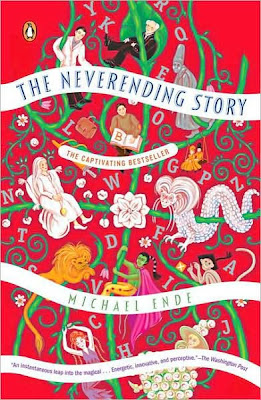 The main character is Bastian, a young pudgy boy who loves books. By reading books he is able to escape the harsh reality around him: the empty place left by his mother's death and the taunting of his classmates about his weight. But one day Bastian stumbles into a bookshop and discovers an unusual book entitled “The Neverending Story.” With no money to buy it, Bastian steals the book and takes it away to read it in the seclusion of his school's attic.
In the dusty space above the classrooms where other children are hard at work Bastian begins a journey that he will never forget. The Neverending Story is more than a book, it is an entrance to an entire fantastic world, a world in danger. Only Bastian can save the characters and world of The Neverending Story, and he can only do this is he enters the story itself!
I thoroughly enjoyed “The Neverending Story.” Michael Ende's prose has a tone reminiscent of Tolkien's epic stories, but with a personal touch that amazes me. The plot will appeal to all book lovers who have sometimes wished that they could somehow experience firsthand the marvelous worlds that they read about in books. The characters in “The Neverending Story” are as varied as they are rich. Michael Ende doesn't just stick to the usual fairy tale fare: elves, trolls, and fairies. Rather Michal Ende has created a whole host of unique creatures and races to populate his story.
“The Neverending Story” is a lovely book that is sure to thrill all book lovers.
Inkweaver Book Rating:
 The main character is Bastian, a young pudgy boy who loves books. By reading books he is able to escape the harsh reality around him: the empty place left by his mother's death and the taunting of his classmates about his weight. But one day Bastian stumbles into a bookshop and discovers an unusual book entitled “The Neverending Story.” With no money to buy it, Bastian steals the book and takes it away to read it in the seclusion of his school's attic.
In the dusty space above the classrooms where other children are hard at work Bastian begins a journey that he will never forget. The Neverending Story is more than a book, it is an entrance to an entire fantastic world, a world in danger. Only Bastian can save the characters and world of The Neverending Story, and he can only do this is he enters the story itself!
I thoroughly enjoyed “The Neverending Story.” Michael Ende's prose has a tone reminiscent of Tolkien's epic stories, but with a personal touch that amazes me. The plot will appeal to all book lovers who have sometimes wished that they could somehow experience firsthand the marvelous worlds that they read about in books. The characters in “The Neverending Story” are as varied as they are rich. Michael Ende doesn't just stick to the usual fairy tale fare: elves, trolls, and fairies. Rather Michal Ende has created a whole host of unique creatures and races to populate his story.
“The Neverending Story” is a lovely book that is sure to thrill all book lovers.
Inkweaver Book Rating:
Plot
Characters
Presentation
Overall
“The Dead & The Gone,” by Susan Beth Pfeffer
Other related posts:
5 Star Books,
Science Fiction,
Young Adult Books
“The Dead & The Gone,” by Susan Beth Pfeffer is a stunning science fiction fantasy about the effects of a disastrous asteroid strike that jars the moon into a new orbit closer to earth.

When seventeen-year-old Alex Morales heard that an asteroid was predicted to strike the moon he didn't realize that it was the end of the world as he knew it. He thought that this was just another overplayed media event, or maybe just something interesting for the astronomers to study. Alex was more concerned about getting elected as senior class president at his exclusive New York City school.
Inkweaver Review is currently moving to a new web location. Please read the rest of this review at out new website:
Review of "The Dead and the Gone" by Susan Beth Pfeffer

When seventeen-year-old Alex Morales heard that an asteroid was predicted to strike the moon he didn't realize that it was the end of the world as he knew it. He thought that this was just another overplayed media event, or maybe just something interesting for the astronomers to study. Alex was more concerned about getting elected as senior class president at his exclusive New York City school.
Inkweaver Review is currently moving to a new web location. Please read the rest of this review at out new website:
Review of "The Dead and the Gone" by Susan Beth Pfeffer
If you enjoyed reading "The Dead and the Gone" or just want to learn more about the author, check out Inkweaver Review's interview with author Susan Beth Pfeffer.
“The Beloved Dearly,” by Doug Cooney
Other related posts:
3 Star Books,
Junior Fiction,
Realistic Fiction
 “The Beloved Dearly,” by Doug Cooney is a heart-warming novel about a young boy who learns the true value of friends while trying to run a pet burial service.
Ernie may be only twelve years old, but he has plenty ideas about how to make money. When he gets in trouble for selling his own cheeseburgers in the cafeteria at school its the last straw, though. Ernie's father tells him that if he finds out that Ernie is trying to make money off people again he will ground him.
But then Ernie finds an abandoned lot, and the perfect business: pet burials.
Inkweaver Review is moving to a new web address. Please read the rest of this review at its new location:
Review of/Buy "The Beloved Dearly" by Doug Cooney
"The Very Hungry Caterpillar" by Eric Carle
Other related posts:
3 Star Books,
Animals,
Junior Fiction
"The Very Hungry Caterpillar" by Eric Carle is forty years old today. This classic children's picture book has been entertaining young readers since it was first published in 1969.

The storyline focuses on the life of a small caterpillar as it eats a variety of different foods, one apple and the pages of the book itself on Monday, two pears on Tuesday, three plums on Wednesday, and so on. Finally the small caterpillar is fat and has a stomache. He goes into his pupa and emerges as a beautiful butterfly.
Eric Carle's "The Very Hungry Caterpillar" does a great job of teaching young readers about the life cycle of a caterpillar. It also teaches basic counting and the names of different food types. All of these positive aspects of "The Very Hungry Caterpillar" have made it one of the most popular children's books ever published, with millions of copies in 20 different languages sold to date.
One slightly interesting aspect of the story is that the caterpillar enters a cocoon, rather than a chrysalis. Some readers may wonder about this seemingly unscientific fact, but according to Eric Carle's explanation there actually are rare species of caterpillars that undergo metamorphosis in a cocoon. However, Eric Carle says that he put his caterpillar in a cocoon not because he knew of these strange caterpillars but because his father always used to say to him, "Eric, come out of your cocoon."
The pictures in Eric Carle's "The Very Hungry Caterpillar" are made of tissue paper. This gives them a a rough but attractive quality reminiscent of the hand drawn picture so of children. For this reason they are bound to appeal to young readers.
Soon readers can expect to enjoy "The Very Hungry Caterpillar" and its pictures in a brand new format. The official Eric Carle website says, "In March, a special edition of the book, The Very Hungry Caterpillar Pop-Up Book featuring Eric Carle’s illustrations in a 3-dimensional format, will be available for sale at your local bookstore."
Also anyone interested in the book should enjoy the 40th anniversary video, with Eric Carle talking about his book.
"The Very Hungry Caterpillar" by Eric Carle is a classic piece of fiction that all young readers and their parents are sure to enjoy together.

The storyline focuses on the life of a small caterpillar as it eats a variety of different foods, one apple and the pages of the book itself on Monday, two pears on Tuesday, three plums on Wednesday, and so on. Finally the small caterpillar is fat and has a stomache. He goes into his pupa and emerges as a beautiful butterfly.
Eric Carle's "The Very Hungry Caterpillar" does a great job of teaching young readers about the life cycle of a caterpillar. It also teaches basic counting and the names of different food types. All of these positive aspects of "The Very Hungry Caterpillar" have made it one of the most popular children's books ever published, with millions of copies in 20 different languages sold to date.
One slightly interesting aspect of the story is that the caterpillar enters a cocoon, rather than a chrysalis. Some readers may wonder about this seemingly unscientific fact, but according to Eric Carle's explanation there actually are rare species of caterpillars that undergo metamorphosis in a cocoon. However, Eric Carle says that he put his caterpillar in a cocoon not because he knew of these strange caterpillars but because his father always used to say to him, "Eric, come out of your cocoon."
The pictures in Eric Carle's "The Very Hungry Caterpillar" are made of tissue paper. This gives them a a rough but attractive quality reminiscent of the hand drawn picture so of children. For this reason they are bound to appeal to young readers.
Soon readers can expect to enjoy "The Very Hungry Caterpillar" and its pictures in a brand new format. The official Eric Carle website says, "In March, a special edition of the book, The Very Hungry Caterpillar Pop-Up Book featuring Eric Carle’s illustrations in a 3-dimensional format, will be available for sale at your local bookstore."
Also anyone interested in the book should enjoy the 40th anniversary video, with Eric Carle talking about his book.
"The Very Hungry Caterpillar" by Eric Carle is a classic piece of fiction that all young readers and their parents are sure to enjoy together.
PicturesCharactersPresentationOverall
“The Adoration of Jenna Fox,” by Mary E. Pearson
Other related posts:
5 Star Books,
Science Fiction,
Utopian/Dystopian,
Young Adult Books
“The Adoration of Jenna Fox,” by Mary E. Pearson is a science fiction novel about medical technology ethics in the future.

When seventeen-year-old Jenna awakes from a year-long coma she doesn't even remember her name. At first she is in a daze, unable to think clearly about anything, but as she gradually recuperates memories and questions begin to surface in her mind. Not only are the memories that are coming back to her strange, but so is her parent's behavior. Why did they move to an old home in a remote country location just days before she woke up? And why are they so hesitant to let other people see her?
Inkweaver Review is in the process of moving to a new website. To read the rest of this review please come to our new location:
Review of "The Adoration of Jenna Fox" by Mary E. Pearson

When seventeen-year-old Jenna awakes from a year-long coma she doesn't even remember her name. At first she is in a daze, unable to think clearly about anything, but as she gradually recuperates memories and questions begin to surface in her mind. Not only are the memories that are coming back to her strange, but so is her parent's behavior. Why did they move to an old home in a remote country location just days before she woke up? And why are they so hesitant to let other people see her?
Inkweaver Review is in the process of moving to a new website. To read the rest of this review please come to our new location:
Review of "The Adoration of Jenna Fox" by Mary E. Pearson
Book Review Blog Carnival
Other related posts:
Website Messages
Once again Inkweaver Review has been featured in the Book Review Blog Carnival. This time the carnival is hosted at Bookish Ruth.
Please stop by and check it out!
Please stop by and check it out!
“Beatnik Rutabagas from Beyond the Stars,” by Quentin Dodd
Other related posts:
4 Star Books,
Humorous Books,
Junior Fiction,
Science Fiction
“Beatnik Rutabagas from Beyond the Stars,” by Quentin Dodd is a humorous science fiction story about two best friends who are abducted by opposing alien armies to serve as generals.
 Walter Nutria is a young teenage boy who can't stand school. The teachers don't do their jobs right and seem to show favoritism. It is little wonder, then, that he skips school. The only thing that Walter really likes is watching sci-fi films with his best friend Yselle Meridian, a cool girl who seems to like Walter or maybe she just likes renting videos on Walter's card!
But Walter's life changes abruptly when he cuts school one day and finds an alien spaceship waiting to pick him up. The aliens quickly tell him their reason for wanting him:
“Nearly half your motion-picture entertainment was about courageous Earth people fighting off alien invaders, often against incredible odds! Soon it became clear to us that every single inhabitant of Planet Earth must be an expert in space conflicts! It was the perfect opportunity!
So we checked the video rental records to find out who had seen the most films. That person would obviously be the greatest general.”
Invited because of his movie watching skills and promised pay in the form of a year's worth of production from the famous Lirgonian nougat mines, Walter can't really turn the offer down. But soon previously undiscussed issues crop up, such as the fact that the Ligonians have only one spaceship in their fleet. Then Walter finds out that his best friend Yselle has been taken on as the general of the Wotwots, the opposing force that the Lirgonians want Walter to help them defeat. The only good thing is that the Wotwots have only one spaceship too!
When the first face off ends in a humiliating game of chicken that leaves both ships damaged and stuck to each other, Walter and Yselle are grateful that nothing worse happened. At the intergalactic repair shop, though, the war between the Wotwots and Lirgonians is put on hold when both alien ships are stolen by Space Mice from Galaxy Four.
These mysterious mice are the scourge of the galaxy, constantly stealing important things. No one is sure exactly what these electric blue rodents do with the things that they steal, all that's known for sure is that they were first seen near Galaxy Four. Both alien groups are eager to get their spaceships back. As Walter, Yselle and their alien friends try to track down the Space Mice it becomes obvious that more is at stake than two lost spaceships. In fact, the fate of the whole universe might be involved!
“Beatnik Rutabagas from Beyond the Stars,” is definitely a well-written book. The humor is well designed, never crude or forced. Quentin Dodd's plot is interesting and its unusual alien characters enliven the storyline. I definitely recommend “Beatnik Rutabagas from Beyond the Stars,” to all young science fiction lovers.
Inkweaver Book Rating:
 Walter Nutria is a young teenage boy who can't stand school. The teachers don't do their jobs right and seem to show favoritism. It is little wonder, then, that he skips school. The only thing that Walter really likes is watching sci-fi films with his best friend Yselle Meridian, a cool girl who seems to like Walter or maybe she just likes renting videos on Walter's card!
But Walter's life changes abruptly when he cuts school one day and finds an alien spaceship waiting to pick him up. The aliens quickly tell him their reason for wanting him:
“Nearly half your motion-picture entertainment was about courageous Earth people fighting off alien invaders, often against incredible odds! Soon it became clear to us that every single inhabitant of Planet Earth must be an expert in space conflicts! It was the perfect opportunity!
So we checked the video rental records to find out who had seen the most films. That person would obviously be the greatest general.”
Invited because of his movie watching skills and promised pay in the form of a year's worth of production from the famous Lirgonian nougat mines, Walter can't really turn the offer down. But soon previously undiscussed issues crop up, such as the fact that the Ligonians have only one spaceship in their fleet. Then Walter finds out that his best friend Yselle has been taken on as the general of the Wotwots, the opposing force that the Lirgonians want Walter to help them defeat. The only good thing is that the Wotwots have only one spaceship too!
When the first face off ends in a humiliating game of chicken that leaves both ships damaged and stuck to each other, Walter and Yselle are grateful that nothing worse happened. At the intergalactic repair shop, though, the war between the Wotwots and Lirgonians is put on hold when both alien ships are stolen by Space Mice from Galaxy Four.
These mysterious mice are the scourge of the galaxy, constantly stealing important things. No one is sure exactly what these electric blue rodents do with the things that they steal, all that's known for sure is that they were first seen near Galaxy Four. Both alien groups are eager to get their spaceships back. As Walter, Yselle and their alien friends try to track down the Space Mice it becomes obvious that more is at stake than two lost spaceships. In fact, the fate of the whole universe might be involved!
“Beatnik Rutabagas from Beyond the Stars,” is definitely a well-written book. The humor is well designed, never crude or forced. Quentin Dodd's plot is interesting and its unusual alien characters enliven the storyline. I definitely recommend “Beatnik Rutabagas from Beyond the Stars,” to all young science fiction lovers.
Inkweaver Book Rating:
Plot
Characters
Presentation
Overall
“Waiting for Normal”, by Leslie Connor
Other related posts:
3 Star Books,
Junior Fiction,
Modern Novels,
Realistic Fiction
 “Waiting for Normal”, by Leslie Connor is a touching novel about a young girl who must cope with her rather unreliable mother after being separated from her stepfather and half-sisters.
Addie loves her mother, but unfortunately Addie's mom tends to take an all or nothing approach to life. One day she will work hard to clean up their small trailer near the railroad tracks, and then the next day she will lay around in bed all day and let the dirty dishes pile up. Some days she comes home with bags full of groceries and makes wonderful meals for Addie, but then she'll be gone for weeks on a “business trip.” Just when the pantry is beginning to get empty, though, Addie's mom will return again and Addie can't really be mad at her then.
Inkweaver Review is moving to a new web address. Please read the rest of this review at its new location:
Review of "Waiting For Normal" by Leslie Connor
“Atherton – Rivers of Fire,” by Patrick Carman
Other related posts:
5 Star Books,
Science Fiction,
Utopian/Dystopian,
Young Adult Books
“Atherton – Rivers of Fire,” by Patrick Carman is the stunning sequel to “Atherton – The House of Power.” The Atherton series is about a strange world created by a mad scientist.
In “Atherton – The House of Power” readers were introduced to young Edgar, an adventurous boy who dares to violate one of the most important rules of his strange world: “Stay away from the cliffs.” When Edgar starts climbing the cliffs that lead between the three levels of the world of Atherton he discovers that there is a deep and dark secret behind his world. The people of Atherton have been retrained so that they think that they have always lived on Atherton, but in truth their world is a scant thirty years old.
Atherton is giant man-made satellite that orbits the polluted, dying earth. Although this new world was created as a safe haven for people from Earth, it was created by a mad scientist named Dr. Harding. What is more, it appears that Atherton is not yet done developing. When the cliffs of Atherton collapse it sets of a chain of events that provokes civil war and throws the inhabitants of Atherton into great danger.
At the time that “Atherton – Rivers of Fire” begins Edgar is making his way to the middle of Atherton. Here Atherton's former paradise is now sinking into the center of the world and flooding with the very waters that Atherton's cruel ruler at one time held back to control the people. Edgar and his two friends Samuel and Isabel venture into the depths of Atherton in search of Dr. Harding, the strange man who created Atherton. Only he knows what is happening to Atherton and what will happen to his creation in the end.
Patrick Carman's Atherton series is simply amazing. The storyline has so many subtle details and amazing ingredients. Although the plot is intensely complicated, involving many characters and important developments, Carman does a good job of presenting the world of Atherton one piece at a time until it can stand along in the reader's mind. The characters in “Atherton – Rivers of Fire” are very well developed. Readers of this sequel will be happy to find out more about the enigmatic Dr. Harding and the secrets that he has built into his endless creation.
I definitely recommend “Atherton – Rivers of Fire.” The “Atherton” series is a great science fiction story that young readers are sure to enjoy.
Inkweaver Book Rating:

In “Atherton – The House of Power” readers were introduced to young Edgar, an adventurous boy who dares to violate one of the most important rules of his strange world: “Stay away from the cliffs.” When Edgar starts climbing the cliffs that lead between the three levels of the world of Atherton he discovers that there is a deep and dark secret behind his world. The people of Atherton have been retrained so that they think that they have always lived on Atherton, but in truth their world is a scant thirty years old.
Atherton is giant man-made satellite that orbits the polluted, dying earth. Although this new world was created as a safe haven for people from Earth, it was created by a mad scientist named Dr. Harding. What is more, it appears that Atherton is not yet done developing. When the cliffs of Atherton collapse it sets of a chain of events that provokes civil war and throws the inhabitants of Atherton into great danger.
At the time that “Atherton – Rivers of Fire” begins Edgar is making his way to the middle of Atherton. Here Atherton's former paradise is now sinking into the center of the world and flooding with the very waters that Atherton's cruel ruler at one time held back to control the people. Edgar and his two friends Samuel and Isabel venture into the depths of Atherton in search of Dr. Harding, the strange man who created Atherton. Only he knows what is happening to Atherton and what will happen to his creation in the end.
Patrick Carman's Atherton series is simply amazing. The storyline has so many subtle details and amazing ingredients. Although the plot is intensely complicated, involving many characters and important developments, Carman does a good job of presenting the world of Atherton one piece at a time until it can stand along in the reader's mind. The characters in “Atherton – Rivers of Fire” are very well developed. Readers of this sequel will be happy to find out more about the enigmatic Dr. Harding and the secrets that he has built into his endless creation.
I definitely recommend “Atherton – Rivers of Fire.” The “Atherton” series is a great science fiction story that young readers are sure to enjoy.
Inkweaver Book Rating:
Plot
Characters
Presentation
Overall
“Atherton – The House of Power,” by Patrick Carman
Other related posts:
5 Star Books,
Science Fiction,
Utopian/Dystopian,
Young Adult Books
“Atherton – The House of Power,” by Patrick Carman is the first book in a science fiction series about a world created by a mad scientist.
 Young Edgar lives on the world of Atherton. Atherton has a round bottom like a half sphere, and from this base two terraces emerge. Edgar has grown up on the middle terrace of Atherton. On the terrace above live the elite ruling class of Atherton, who control the world's water supply. If the people on the middle terrace don't produce enough food to please the people above then the water supply will be cut off. But even though life on the middle level of Atherton is difficult it is still better than life on the bottom level of Atherton, which is rumored to be a parched desert where dangerous beasts live.
Edgar is different from the other people of Atherton, because he alone is willing to violate one of the most important rules of Atherton: Stay away from the cliffs. Edgar spends his nights climbing the rocky cliffs that lead to the highest level of Atherton. Then Edgar finds a mysterious journal hidden in the cliff side. There is only one problem, Edgar can't read, and the only people on Atherton who can read are the rulers above him. When Edgar makes the dangerous climb up to the top of Atherton in search of someone who can read the journal to him it is the start of a dangerous series of events that will change Atherton completely.
If I had to choose just one word to describe “Atherton – The House of Power” it would be “vivid.” Patrick Carman's passages are chock full of subtle details and the massively complicated world dominates the storyline. As the reader learns more about Atherton and its mysterious origin the story becomes more and more thrilling. I highly recommend “Atherton – The House of Power” to all science fiction lovers.
Inkweaver Book Rating:
 Young Edgar lives on the world of Atherton. Atherton has a round bottom like a half sphere, and from this base two terraces emerge. Edgar has grown up on the middle terrace of Atherton. On the terrace above live the elite ruling class of Atherton, who control the world's water supply. If the people on the middle terrace don't produce enough food to please the people above then the water supply will be cut off. But even though life on the middle level of Atherton is difficult it is still better than life on the bottom level of Atherton, which is rumored to be a parched desert where dangerous beasts live.
Edgar is different from the other people of Atherton, because he alone is willing to violate one of the most important rules of Atherton: Stay away from the cliffs. Edgar spends his nights climbing the rocky cliffs that lead to the highest level of Atherton. Then Edgar finds a mysterious journal hidden in the cliff side. There is only one problem, Edgar can't read, and the only people on Atherton who can read are the rulers above him. When Edgar makes the dangerous climb up to the top of Atherton in search of someone who can read the journal to him it is the start of a dangerous series of events that will change Atherton completely.
If I had to choose just one word to describe “Atherton – The House of Power” it would be “vivid.” Patrick Carman's passages are chock full of subtle details and the massively complicated world dominates the storyline. As the reader learns more about Atherton and its mysterious origin the story becomes more and more thrilling. I highly recommend “Atherton – The House of Power” to all science fiction lovers.
Inkweaver Book Rating:
Plot
Characters
Presentation
Overall
“Code Orange,” by Caroline B. Cooney
Other related posts:
5 Star Books,
Realistic Fiction,
Science Fiction,
Young Adult Books

Mitty Blake has always lived a rather carefree life. He is interested in just two things: listening to music and Olivia, a girl in his advanced science class. But listening to his iPod during science class won't help Mitty to keep his science grade up. And if Mitty doesn't get an upcoming term paper turned in he will be dropped from the class, which will undoubtedly derail his budding romance with Olivia.
Thank you for visiting Inkweaver Review. We are currently in the process of moving to a new web address, so please read the rest of this review at our new website:
Review of "Code Orange" by Caroline B. Cooney
Other Books by Caroline B. Cooney:
Critical Analysis: “The Pearl,” by John Steinbeck
Other related posts:
5 Star Books,
Classic Literature,
Historical Fiction,
Young Adult Books
 “The Pearl,” by John Steinbeck is the story of a poor Indian couple who find a pearl of immense value.
Kino and his wife Juana live in a small brush hut with their young baby Coyotito. At the start of “The Pearl” John Steinbeck shows Kino and his family living a peaceful life filled with the sound of the whispering surf, and the beautiful “Song of the Family,” the song of safety and warmth.
In the midst of this pleasant scene Steinbeck introduces the first evil which will touch Kino and his family: a scorpion which threatens the baby Coyotito. It crawls down the rope from which Coyotito’s cradle is suspended. Kino and Juana try to catch it before it reaches their baby but Coyotito reaches up and knocks it off onto himself. Kino snatches up the scorpion and smashes into the earth, but it is too late, for Coyotito wails in anguish. The poison of the scorpion that stung him would make a full grown man very sick. For the baby, though, the poison may be deadly.
Kino and Juana decide to take Coyotito to the local village doctor. Steinbeck first paints a picture of the doctor at ease inside his gated estate, eating sweets and dreaming of his former opulent lifestyle in France. When a servant disturbs the doctor with news of Kino’s plea for help the rich man’s first response is rage. “I am a doctor, not a veterinary,” the doctor says, implying that Kino and his baby are animals because they are not rich like he is. The doctor says that he will not treat Coyotito unless Kino can pay him. When the servant returns to ask Kino if he has any money to pay for treatment Kino presents all of his savings: eight small, warped seed pearls of very little value.
The doctor’s servant soon returns to Kino and gives him back the eight small pearls. “The doctor has gone out. He was called to a serious case,” the servant lies and closes the gate in Kino’s face. Kino stands there for a moment and then strikes the gate with his fist. Standing before the door that has been so cruelly closed on him Kino looks down at his split, bloody knuckles.
It is at this point that John Steinbeck first shows the desire for money at work in Kino and Juana. They treat Coyotito with a poultice made of seaweed, but unsure of how effective it will be they decide to go out to the pearl beds to find a pearl better than the ones they have saved up. Steinbeck shows Juana’s thinking process:
“She had not prayed directly for the recovery of the baby—she had prayed that they might find a pearl with which to hire the doctor to cure the baby.”
It is at this point in “The Pearl” that Kino and Juana begin thinking of riches, in this case a pearl, as the solution to their problems.
Kino dives down into the oyster bed and begins filling his basket with pearls. As chance has it he glimpses a very large oyster hidden beneath an overhang. Before the shell closes, Kino sees the gleam of what may be a pearl inside. Kino immediately returns to the surface with the great oyster.
Although Kino is excited about what he saw he does not rush things. Instead he takes the time to pull up his diving rock and his basket of oysters. At this critical moment in the story Steinbeck introduces a very important idea:
“It is not good to want a thing too much. It sometimes drives the luck away. You must want it just enough, and you must be very tactful with God or the gods.”
In line with this principal Kino opens one of the oysters from the basket first. When he has inspected it and found it to contain nothing he throws the oyster overboard and then picks up the large oyster, pretending to notice it for the first time. Kino cuts open the oyster’s shell and pulls back the flesh. Inside the oyster is a huge pearl, as large as a seagulls egg. Steinbeck describes Kino and Juana’s response on seeing it for the first time:
“Juana caught her breath and moaned a little. And to Kino the secret melody of the maybe pearl broke clear and beautiful, rich and warm and lovely, glowing and gloating and triumphant. In the surface of the pearl he could see dream forms. He picked the pearl from the dying flesh and held it in his palm, and he turned it over and saw that its curve was perfect. Juana came near to stare at it in his hand, and it was the hand he had smashed against the doctor’s gate, and the torn flesh of the knuckles was turned grayish white by the sea water.”
At first Steinbeck shows the pearl as a wonderful thing. It is the key that will allow Kino and Juana to achieve all of their dreams, and it will forever raise them above the embarrassing state of poverty that limited them in the past. Now that Kino has the pearl he can dare to let himself dream of things that were before impossible. Kino’s brother Juan asks “What will you do now that you have become a rich man?” Kino thinks carefully. “We will be married—in the church.” Kino can see Juana and himself standing before all the others in the church. “We will have new clothes,” Kino says. From there is is but a small leap to further extravagance: “A rifle. Perhaps a rifle.” The rifle breaks down all barriers in Kino’s mind. If he can have a rifle then he can have anything he wants, all thanks to the pearl.
“My son will go to school. My son will read and open books, and my son will write and will know writing. And my son will make numbers, and these things will make us free because he will know—he will know and through him we will know. This is what the pearl will do.”
Kino’s grand plans are intrinsically tied to the benefit that the pearl can bring to him. However, even as he dreams of the riches of the pearl, others in his village also desire a share of Kino’s wealth. Steinbeck shows a broad view of how the pearl affects everyone in the village, from the clergy who think to themselves about how money could help them repair the church, to shopkeepers who make sure that their clothes are in good order, to the evil doctor who dreams of returning to France and eating in a fancy restaurant. Even the beggars “giggle with pleasure, for they [know] that there is no almsgiver in the world like a poor man who is suddenly lucky.”
Now that the pearl is in Kino’s hands “all manner of people” become interested in him. One of the first people to visit him is the village priest. With the pearl in his hand Kino finds that he no longer trusts the priest. He looks forward to the time when his son Coyotito will be grown up, when he will have learned to read and write. Then Coyotito can read the holy books and know what things are true and what things are not. The priest encourages Kino to remember God and give thanks for his good fortune.
On the heels of the priest comes the doctor. Now that Kino has money the doctor is very willing to treat baby Coyotito. By now the danger from the scorpion poison has already passed, but the doctor takes advantage of Kino and Juana’s ignorance to tell them that the baby is in mortal danger. The doctor gives Coyotito a “medicine,” really poison, and tells them that the “medicine” will help hold off the ill effects of the scorpion. However, he warns them that the “scorpion poison” may strike again. Sure enough, within an hour Coyotito becomes very sick, but it is not from the scorpion, but rather the “medicine” that the doctor gave to him. Kino and Juana are suspicious of the doctor’s actions but they can not tell for sure that he is not telling the truth.
That night Kino starts to become afraid that someone will steal the pearl from him. He digs it up from the place where he had hidden it and buries it under his sleeping mat. Juana watches him and asks “Who do you fear?” Kino answers “Everyone.”
It is at this point that the pearl first becomes a thing of evil. During the night a thief enters the hut to try to steal the pearl. In the dark Kino stabs wildly and injures the thief. The thief escapes after dealing Kino a massive blow to the head. As Juana dresses his wound she for the first time encourages Kino to get rid of the pearl. “This thing is evil. This pearl is like a sin! It will destroy us.”
Kino can not part with pearl though. For him it is the family’s only chance. The next morning Kino and his wife dress in their best clothing and go to the pearl buyers to sell the great pearl. Most of the villagers turn out for the event. They want to see the “Pearl of the World” sold, and they want to see how much Kino gets for it. Little do Kino and the other villagers realize, but all the pearl buyers in the village have been cheating the pearl divers for years. They agree in advance to buy pearls for much below their true value. When Kino shows his pearl to the appraiser the man tells him that is like fools gold, nothing but a curiosity. He offers Kino a thousand pesos.
In anger Kino refuses the offer, stating that the pearl is worth fifty thousand pesos. He announces that he will take the pearl to the capital, where he can get a fair price for it. In defying the pearl dealers in this way Kino threatens the entire structure of life in his village. The pearl makes him think great thoughts and makes him wish to break free from the oppression of the rich people who have abused the Indians for so many years.
Again Kino is attacked in the night by a thief who wishes to steal the pearl. Kino manages to repel the attacker but he receives a scalp wound that leaves him only half conscious. Again Juana begs Kino to throw away the pearl before it destroys them. Again Kino refuses.
In the morning Juana secretly takes the pearl out of hiding and goes down to the beach to throw it back into the sea from which it came. Kino follows Juana and stops her before she can throw the pearl away. In a mad rage Kino strikes Juana across the face and kicks her in the side when she falls to the ground.
His rage replaced with disgust Kino walks away, but before he is even out of sight a group of men ambush him to steal the pearl. Kino kills one of them with his knife, but the pearl is knocked out of his hands onto the sand. The men do not see it and they think that Kino does not have the pearl with him. They strike him down and leave him for dead.
Juana comes to Kino’s rescue. She picks up the pearl and tends to Kino. When his senses return Kino’s first thought is of the pearl. “They have taken the pearl. I have lost it. Now it is over.” The pearl has become Kino’s master, his entire purpose in life. Juana gives him the pearl. “Here is your pearl. Can you understand. You have killed a man. We must go away.”
Kino and Juana have no option now but to flee. When Kino inspects his boat though he finds that a huge hole has been knocked in the bottom. The boat was a family relic passed down through by his grandfather, then his father. To Kino the breaking of the boat is an evil thing that fills him with rage.
Just as soon as Kino leaves the beach he finds that someone has set fire to his brush hut. The hut burns to the ground, destroying almost everything Kino and Juana own. They have no choice now but to set off toward the city to sell the pearl. Before Kino goes his brother implores him to get rid of the evil pearl. Kino responds “This pearl has become my soul. If I give it up I shall lose my soul.”
Kino and Juana escape into the wilderness with a few supplies and their infant son. They hide in the bush, and for the first time Kino has time to reflect on what has happened to him because of the pearl.
“When we sell it at last, I will have a rifle,” he said, and he looked into the shining surface for his rifle, but he saw only a huddled dark body on the ground with shining blood dripping from its throat. And he said quickly, “We will be married in a great church.” And in the pearl he saw Juana with her beaten face crawling home through the night. “Our son must learn to read,” he said frantically. And there in the pearl Coyotito’s face, thick and feverish from the medicine.
Kino finally begins to see the evil of the pearl he has found, but he still can not give up the dreams that he has attached to it. Kino and Juana’s situation becomes desperate when they discover that trackers are following them through the wilderness to steal the pearl from them. Kino and Juana flee in fear, but they know that they can not run forever. At nighttime Kino decides to make a stand against the trackers. He has Juana and Coyotito hide inside a cave. Kino himself stays to watch for the coming of the trackers.
The trackers make camp near a small pool of water below Juana and Coyotito’s cave. Kino has just one way to stop them and save himself, his wife, and his son. He determines to steal the rifle and kill the men in their sleep.
Late at night, Kino descends on the trackers’ camp naked, for fear that his light clothing will reveal him. Just as Kino is about to attack the trackers his son Coyotito begins crying. The men instantly become alert. “Coyote maybe,” one of them says. “If it’s a coyote, this will stop it.” One of them raises his rifle and fires into the darkness.
Kino jumps out of hiding and kills the man instantly with his knife. He deliberately murders the other two men, shooting one of them down with the rifle, but it is too late. From the cave he hears the keening cry of his wife. Even through the darkness the tracker’s deadly shot hit Coyotito and killed him.
Kino and Juana return to the village with the bloody bundle that was once their son. They march through the village as everyone watches from behind gates and through windows. They walk past their burned hut and broken canoe to the sea edge.
Kino’s hand shakes as he pulls out the pearl. Now he sees it as a “malignant growth,” a thing of unbelievable evil that has destroyed his family and life. Kino holds the pearl out to Juana to throw away but Juana shakes her head. “No, you.” Kino pulls back his arm and flings the pearl far out over the waves.
Against Juana’s better judgment Kino’s desires have wrecked their family, but Juana does not seem to hold Kino responsible. She recognizes that what Kino did was what any man would have had to do. As Steinbeck puts it Juana sees Kino as “half insane, half god,” willing to “drive his strength against a mountain, and plunge his strength against the sea.” By making Kino throw the pearl away himself she gives him a chance to recover some of his manhood and his ruined honor. But Kino and Juana can never be happy with their life again. Before the pearl they were satisfied with their son and their simply living. Now that the pearl has given Kino and Juana a taste for riches, and provoked them to dream of things greater they will never be able to look at their lives without thinking of how things could have been.
At first glance Steinbeck’s “The Pearl” is a potent criticism of materialism and the American dream to become rich and successful. Steinbeck shows the evils that result from putting riches first in life. However, Steinbeck also weaves much deeper themes into “The Pearl.” One major aspect of “The Pearl” is the continual contrast between Kino and Juana. Juana possesses more common sense and foresight to see right from the start that the pearl is something that will hurt the family more than help. Kino, though, becomes obsessed with protecting the pearl for the benefit of the family. He dreams of a grand future for Coyotito, not recognizing that the pearl is more of a danger for his family than a help. His fanaticism becomes fully developed when he abuses his wife for trying to get rid of the pearl. In this way Steinbeck explores the difference between male and female thinking and the psychological differences between Kino and Juana.
“The Pearl” is in part a spiritual journey. Each of the story elements have a flavor of either “good” or “evil.” The doctor and pearl buyers are evil. In contrast, Coyotito is a “savior” in that Kino wants him to get an education so that he can free the family and others from the oppressive rule of the rich. Throughout “The Pearl” Steinbeck also shows Juana praying, both to God and the gods, using both the Our Father, and the traditional magics. In a way “The Pearl” is a reflection of the Biblical parable found at Matthew 13:45,46. In this Bible passage a merchant finds a pearl of great value, and sells everything he has to own it. In this case, though, the pearl is a metaphor for God’s Kingdom, whereas in Steinbeck’s story the pearl is a thing of evil, a metaphor for greed and wealth in general.
Interestingly Steinbeck wrote “The Pearl” in response to a suggestion from friends in Mexico who encouraged him to write a screenplay for a film to be produced and filmed in Mexico. Throughout “The Pearl” readers can note ways in which Steinbeck specifically aimed the text toward cinematic effects. One of these is the point of view, which tends to be either close-up, or at medium or distant range. The scenes described are well suited for filming, both because of their typically sparse use of characters, and their powerful emotional and action content. In addition, Steinbeck uses music keys that would be expected in a movie, but are slightly hard to imagine in a written story. As Kino fears for the pearl Steinbeck mentions “The Song of Evil,” low and haunting. In contrast the warm “Song of the Family” percolates through Kino and Juana’s life. At first when Kino looks at the pearl he hears the “Song of the Pearl” as something more like “The Song of the Family” in that the pearl will help him to improve the family’s life. But later Kino begins to tie “The Song of Evil” with “The Song of the Pearl.” These songs are specifically mentioned to aid in the production of the screenplay for “The Pearl.” The Mexican film of “The Pearl” was released in the United States in 1947 and 1948, and at that point it became the first Mexican made film commercially distributed in the States.
“The Pearl” by John Steinbeck is a many-layered story that teaches a deep lesson about the pursuit of wealth while at the same time exploring the differences between the sexes and the real meaning of family life. Every reader should experience this classic piece of fiction.
“Candyfloss,” by Jacqueline Wilson
Other related posts:
3 Star Books,
Junior Fiction,
Modern Novels,
Realistic Fiction
“Candyfloss,” by Jacqueline Wilson is a touching story about a young girl who chooses to stay with her father at his greasy spoon cafe while her mother lives in Australia for six months with her new husband.
 Flossie loves both of her parents but since their separation she has been staying with her mother. She enjoys visiting her father Charlie on the weekends at his small and not very popular cafe. He feeds her his famous chip butties, sandwiches made with French fries, and takes her to the local carnival.
But when Flossie's mother announces that the family is moving to Australia for six months so that Flossie's stepfather can work at a new branch opening there, Flossie's quickly realizes that it will prevent her weekend visits with her real Dad. So Flossie makes an important decision. She will live with her father for six months rather than going to Australia with her Mom. Needless to say, Flossie's mother feels both angry and sad because Flossie doesn't want to come with them, but she lets her stay with her father.
Charlie does it his best to make things comfortable for his daughter, but unlike Flossie's new stepfather he isn't a successful businessman. When his cafe goes broke and is repossessed by creditors, Flossie and her father have to find a new place to live. At the same time Flossie has to deal with the fact that her popular best friend Rhiannon has found new friends and has started teasing her. But Flossie is sure that she and her father can make things work.
“Candyfloss” is fun to read and is sure to appeal to many young girls. Although the book has a decidedly British flavor, Jacqueline Wilson does a good job in explaining terms and jargon that might otherwise be misunderstood. I enjoyed the characters in “Candyfloss.” It is interesting to compare the British children of Jacqueline Wilson's creation with their American counterparts molded by such authors as Andrew Clements. “Candyfloss” is a book that young girls worldwide are sure to enjoy reading.
 Flossie loves both of her parents but since their separation she has been staying with her mother. She enjoys visiting her father Charlie on the weekends at his small and not very popular cafe. He feeds her his famous chip butties, sandwiches made with French fries, and takes her to the local carnival.
But when Flossie's mother announces that the family is moving to Australia for six months so that Flossie's stepfather can work at a new branch opening there, Flossie's quickly realizes that it will prevent her weekend visits with her real Dad. So Flossie makes an important decision. She will live with her father for six months rather than going to Australia with her Mom. Needless to say, Flossie's mother feels both angry and sad because Flossie doesn't want to come with them, but she lets her stay with her father.
Charlie does it his best to make things comfortable for his daughter, but unlike Flossie's new stepfather he isn't a successful businessman. When his cafe goes broke and is repossessed by creditors, Flossie and her father have to find a new place to live. At the same time Flossie has to deal with the fact that her popular best friend Rhiannon has found new friends and has started teasing her. But Flossie is sure that she and her father can make things work.
“Candyfloss” is fun to read and is sure to appeal to many young girls. Although the book has a decidedly British flavor, Jacqueline Wilson does a good job in explaining terms and jargon that might otherwise be misunderstood. I enjoyed the characters in “Candyfloss.” It is interesting to compare the British children of Jacqueline Wilson's creation with their American counterparts molded by such authors as Andrew Clements. “Candyfloss” is a book that young girls worldwide are sure to enjoy reading.
PlotCharactersPresentationOverall
“Dark Water Rising,” by Marian Hale
Other related posts:
4 Star Books,
Historical Fiction,
Young Adult Books
 “Dark Water Rising,” by Marian Hale is a historical fiction novel about the powerful hurricane that devastated Galveston Island in 1900.
Unlike the rest of his family, sixteen-year-old Seth Braeden is not at all thrilled to be moving to Galveston. Sure he enjoys the great weather and the swimming at the nearby beaches, but to Seth the move to Galveston thwarts one of his most important dreams. Seth wants to be a carpenter like his father, but the family moved to Galveston so that Seth could attend college there and become a doctor.
Inkweaver Review is moving to a new web address. Please read the rest of this review at its new location:
Review of "Dark Water Rising," by Marian Hale
“A Swiftly Tilting Planet” by Madeline L’Engle
Other related posts:
5 Star Books,
Classic Literature,
Science Fiction,
Young Adult Books
“A Swiftly Tilting Planet” by Madeline L’Engle continues the Murray family saga that began with “A Wrinkle in Time.”
 In this adventure, the world is one day away from destruction by a nuclear war. The youngest Murray, Charles, is given the task of traveling back in time to change the events that lead up to Earth’s current plight. As typical in Madeline L’Engle’s books, unicorns play a key role, taking Charles along the “wind.” To give you a taste of the writing style:
“The great unicorn flung himself into the wind and they were soaring among the stars, part of the dance, part of the harmony. As each flaming sun turned on its axis, a singing came from the friction in the way a finger moved around the rim of a crystal goblet will make a singing, and the song varies in pitch and tone from glass to glass. But this song was exquisite as no song from crystal or wood or brass could be. The blending of melody and harmony was so perfect that it almost made Charles Wallace relax his hold on the unicorn‘s mane.”
“A Swiftly Tilting Planet” mixes suspense and beauty to create a wonderful novel. Madeline L'Engle's books always focus on the all important struggle between good and evil and how even the smallest and seemingly least important things can cascade until they have a large effect. I found “A Swiftly Tilting Planet” very interesting because it showed down through time how a whole serious of events created the future nuclear threat. Madeling L'Engle's message is clear: Even the small things that we do right now could have either a positive or a negative effect in the future.
I would highly recommend “A Swiftly Tilting Planet” to all readers, not just science fiction fans.
Inkweaver Book Rating:
 In this adventure, the world is one day away from destruction by a nuclear war. The youngest Murray, Charles, is given the task of traveling back in time to change the events that lead up to Earth’s current plight. As typical in Madeline L’Engle’s books, unicorns play a key role, taking Charles along the “wind.” To give you a taste of the writing style:
“The great unicorn flung himself into the wind and they were soaring among the stars, part of the dance, part of the harmony. As each flaming sun turned on its axis, a singing came from the friction in the way a finger moved around the rim of a crystal goblet will make a singing, and the song varies in pitch and tone from glass to glass. But this song was exquisite as no song from crystal or wood or brass could be. The blending of melody and harmony was so perfect that it almost made Charles Wallace relax his hold on the unicorn‘s mane.”
“A Swiftly Tilting Planet” mixes suspense and beauty to create a wonderful novel. Madeline L'Engle's books always focus on the all important struggle between good and evil and how even the smallest and seemingly least important things can cascade until they have a large effect. I found “A Swiftly Tilting Planet” very interesting because it showed down through time how a whole serious of events created the future nuclear threat. Madeling L'Engle's message is clear: Even the small things that we do right now could have either a positive or a negative effect in the future.
I would highly recommend “A Swiftly Tilting Planet” to all readers, not just science fiction fans.
Inkweaver Book Rating:
PlotCharactersPresentationOverall
Subscribe to:
Posts (Atom)

