
If you are the owner of a blog that incorporates any slow loading widget then you have probably experienced the seemingly unavoidable effects: the post section loads first, but the background of the post section or sidebar doesn't fill in until everything in your blog's sidebar finishes loading. Or, a slow widget in your sidebar prevents everything else below it from loading until it is done loading. I began experiencing this difficulty myself after I added several widgets to Inkweaver Review's sidebar.
Fortunately I have now developed a technique which eliminates this formerly unpleasant effect. Basically, the internet browser can't finish drawing a page element until everything inside that page element has finished loading. In this case, with the sidebar, the slow loading widget stops the sidebar from being drawn correctly until after the widget has loaded. My solution to this problem is to add code so that the widget loads at the bottom of my blog and then is moved up to its proper position in the sidebar. This can be accomplished in three easy steps.
First add a new HTML/Javascript page element at the bottom of your blog. Place the following code in the new page element:
<div id='cut1'>
//Insert code between here...
//...and here.
</div>
<script type='text/javascript'>
/* <![CDATA[ */
document.getElementById('paste1').innerHTML = document.getElementById('cut1').innerHTML;
document.getElementById('cut1').innerHTML = '';
/* ]]> */
</script>
Second, copy the code for your widget from its place in the sidebar and place the widget code inside the <div> tag, between the two comments.
Lastly, delete the widget code from your sidebar and replace it with the following code:
<div id='paste1'>
</div>
Repeat this process for every widget in your blog's sidebar, but remember that for the second widget you must change the identifying names 'cut1' and 'paste1' to 'cut2' and 'paste2', and so on for every additional widget.
This new code will operate in the following manner. Your blog's post area and sidebar will load extremely fast, because the sidebar starts out with no widgets in it. After that the blog widgets will start to load. As each widget is loaded, the code copies it up to your sidebar, then erases the copy at the bottom of the page. The important thing is that the browser will not have to wait until the widgets load to complete drawing the post area of your blog.
Hopefully this tutorial will help you to improve the load appearance of your blog or web page. If you appreciated this tutorial, then please link back to it from your blog so that others can benefit as well. If you have an difficulty with any of the steps feel free to ask a question in the comments. I will answer it as quickly as possible.

“The Remarkable Life and Times of Eliza Rose,” by Mary Hooper
Other related posts:
1 Star Books,
Historical Fiction,
Modern Novels,
Young Adult Books
“The Remarkable Life and Times of Eliza Rose,” by Mary Hooper, was one of the most disappointing historical novels I have ever read.
 The storyline is set in the seventeenth century. Eliza Rose is a fifteen-year-old girl who travels to London to find her father. Soon she is imprisoned for stealing a mouthful of pastry from a shop. When a woman gains her release from jail Eliza feels that her life is taking a turn for the better. Little does she realize, but everyone in London wants something from her. Eliza travels throughout London using a variety of disguises, but in the end it turns out to be harder that she thought to find what she really wants: a place where she can belong.
“The Remarkable Life and Times of Eliza Rose,” had a plot that could hardly be considered remarkable: the child of rich nobles grows up with a peasant family and then finally discovers her true family. This rather cliché plot forms the backbone of so many books that it almost gets tiring. Usually the author finds a good way to conceal it behind twists and turns in the storyline. Mary Hooper, however, reveals the truth in the book's first few pages, then tries to enliven Eliza's story using sex. From reading “The Remarkable Life and Times of Eliza Rose” one would think that nearly everyone in seventeenth century London was either a prostitute, a mistress, a pimp, or something in-between. Surely there must have been a better way to breathe life into a worn out plot.
Unfortunately, I would have to say that “The Remarkable Life and Times of Eliza Rose” was rather disappointing to me.
 The storyline is set in the seventeenth century. Eliza Rose is a fifteen-year-old girl who travels to London to find her father. Soon she is imprisoned for stealing a mouthful of pastry from a shop. When a woman gains her release from jail Eliza feels that her life is taking a turn for the better. Little does she realize, but everyone in London wants something from her. Eliza travels throughout London using a variety of disguises, but in the end it turns out to be harder that she thought to find what she really wants: a place where she can belong.
“The Remarkable Life and Times of Eliza Rose,” had a plot that could hardly be considered remarkable: the child of rich nobles grows up with a peasant family and then finally discovers her true family. This rather cliché plot forms the backbone of so many books that it almost gets tiring. Usually the author finds a good way to conceal it behind twists and turns in the storyline. Mary Hooper, however, reveals the truth in the book's first few pages, then tries to enliven Eliza's story using sex. From reading “The Remarkable Life and Times of Eliza Rose” one would think that nearly everyone in seventeenth century London was either a prostitute, a mistress, a pimp, or something in-between. Surely there must have been a better way to breathe life into a worn out plot.
Unfortunately, I would have to say that “The Remarkable Life and Times of Eliza Rose” was rather disappointing to me.
 Plot
Plot
 Characters
 Presentation
Overall
“The Big Empty,” by J.B. Stephens
Other related posts:
4 Star Books,
Modern Novels,
Science Fiction,
Utopian/Dystopian,
Young Adult Books
“The Big Empty,” by J.B. Stephens is a science fiction novel about a post disaster world.

Before the plague had been named it had already killed more than half of the world's population. With entire cities wiped out, the United States infrastructure came to a halt. When communication systems and other services failed a military government came to power. The new governments solution was to make the U.S. interior an evacuated zone. With all the survivors moved to the coast lands the nation's infrastructure can be maintained. But inside the evacuated zone, called The Big Empty, government soldiers patrol with orders to shoot to kill.
Seven teenagers, however, will band together in the Big Empty. Some left the populated area because they were on the run, some are just looking to start a new life, and some want to escape the oppressive military government, but they all have one goal: find Novo Mundum, a secret Utopian society that has been established in the heart of The Big Empty.
“The Big Empty” is a very realistic science fiction story. The plot makes sense, and the characters are solid. J.B. Stephen has created a richly detailed world that stands alone very well. Science fiction readers should enjoy this fascinating book.
Inkweaver Book Rating:

Before the plague had been named it had already killed more than half of the world's population. With entire cities wiped out, the United States infrastructure came to a halt. When communication systems and other services failed a military government came to power. The new governments solution was to make the U.S. interior an evacuated zone. With all the survivors moved to the coast lands the nation's infrastructure can be maintained. But inside the evacuated zone, called The Big Empty, government soldiers patrol with orders to shoot to kill.
Seven teenagers, however, will band together in the Big Empty. Some left the populated area because they were on the run, some are just looking to start a new life, and some want to escape the oppressive military government, but they all have one goal: find Novo Mundum, a secret Utopian society that has been established in the heart of The Big Empty.
“The Big Empty” is a very realistic science fiction story. The plot makes sense, and the characters are solid. J.B. Stephen has created a richly detailed world that stands alone very well. Science fiction readers should enjoy this fascinating book.
Inkweaver Book Rating:
Plot CharactersPresentationOverall
“Fergus Crane,” by Paul Stewart and Chris Riddell
Other related posts:
5 Star Books,
Fantasy,
Junior Fiction,
Young Adult Books
“Fergus Crane,” by Paul Stewart and Chris Riddell is the first adventure story in the Far-Flung Adventures series.
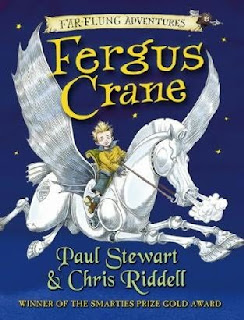 Fergus Crane is a young boy who lives with his mother in an attic home at the top of the Archduke Ferdinand Apartments. Fergus Crane and his mother are very poor, so when the School Ship Betty-Jeanne offers Fergus a free education, both him and his mother are happy to accept. While Fergus attends the school his mother works at a bakery and does odd jobs for the Fateful Voyage Trading Co, a mysterious organization that sends them large paychecks for small jobs.
The plot thickens, however, when Fergus begins receiving strange messages delivered to him in the middle of the night by a flying mechanical box. They indicate that the School Ship Betty-Jeanne is not what it seems and that Fergus is in great danger. When Fergus finally realizes what the messages mean it is already too late. The ship disappears on a “school trip,” leaving Fergus behind, and only Fergus knows that the trip is not what it seems.
Fergus Crane sets out on a mission to save his schoolmates, aided by mechanical wonders created by the Fateful Voyage Trading, Co. A flying mechanical horse and a lunch box that sprouts legs and walks are Fergus' tools in his rescue endeavor.
I enjoyed the detailed world defined by “Fergus Crane.” The rich descriptions written by Paul Stewart, and the beautiful pencil drawings by Chris Riddell are a winning combination that never fail to amaze me. The plot in “Fergus Crane” is exciting and the characters interesting. “Fergus Crane” is a fantasy story that any young reader will enjoy.
 Fergus Crane is a young boy who lives with his mother in an attic home at the top of the Archduke Ferdinand Apartments. Fergus Crane and his mother are very poor, so when the School Ship Betty-Jeanne offers Fergus a free education, both him and his mother are happy to accept. While Fergus attends the school his mother works at a bakery and does odd jobs for the Fateful Voyage Trading Co, a mysterious organization that sends them large paychecks for small jobs.
The plot thickens, however, when Fergus begins receiving strange messages delivered to him in the middle of the night by a flying mechanical box. They indicate that the School Ship Betty-Jeanne is not what it seems and that Fergus is in great danger. When Fergus finally realizes what the messages mean it is already too late. The ship disappears on a “school trip,” leaving Fergus behind, and only Fergus knows that the trip is not what it seems.
Fergus Crane sets out on a mission to save his schoolmates, aided by mechanical wonders created by the Fateful Voyage Trading, Co. A flying mechanical horse and a lunch box that sprouts legs and walks are Fergus' tools in his rescue endeavor.
I enjoyed the detailed world defined by “Fergus Crane.” The rich descriptions written by Paul Stewart, and the beautiful pencil drawings by Chris Riddell are a winning combination that never fail to amaze me. The plot in “Fergus Crane” is exciting and the characters interesting. “Fergus Crane” is a fantasy story that any young reader will enjoy.
 Characters

 Overall
“Emmy and the Incredible Shrinking Rat,” by Lynne Jonell
Other related posts:
3 Star Books,
Animals,
Junior Fiction
“Emmy and the Incredible Shrinking Rat,” by Lynne Jonell is a junior fiction novel that is surprisingly well designed and entertaining.

Emmy is young girl who always tries to be good. She does her all homework, gets straight A's, and eats her vegetables, but for some reason no one seems to notice her. Not only do people forget her name, but they seem to look straight through her. Emmy's parents are always away on business travels and they too seem to forget about her most of the time.
But then Emmy's life changes when she forms a relationship with the classroom pet, a sulky and obnoxious rat that enjoys biting that hands that would feed it. No one else seems to notice that the rat can speak. But when Emmy opens the cage, giving the rat its freedom it begins a chain of events that will reveal a strange collection of rats with marvelous powers, an underground rodent city, and a deadly plot being carried out by Emmy's nanny.
When I first selected “Emmy and the Incredible Shrinking Rat” to add to my reading list I was a little dubious, expecting the average junior fiction novel with overly exaggerated characters, a disappointing plot, etc. However, “Emmy and the Incredible Shrinking Rat” is not what it seems at first glance. The story is surprisingly well created, with a complex plot that was actually quite entertaining. The unique plot ideas that Lynne Jonell has created make the story refreshingly different. “Emmy and the Incredible Shrinking Rat” is an excellent and very well written story for junior audiences.

Emmy is young girl who always tries to be good. She does her all homework, gets straight A's, and eats her vegetables, but for some reason no one seems to notice her. Not only do people forget her name, but they seem to look straight through her. Emmy's parents are always away on business travels and they too seem to forget about her most of the time.
But then Emmy's life changes when she forms a relationship with the classroom pet, a sulky and obnoxious rat that enjoys biting that hands that would feed it. No one else seems to notice that the rat can speak. But when Emmy opens the cage, giving the rat its freedom it begins a chain of events that will reveal a strange collection of rats with marvelous powers, an underground rodent city, and a deadly plot being carried out by Emmy's nanny.
When I first selected “Emmy and the Incredible Shrinking Rat” to add to my reading list I was a little dubious, expecting the average junior fiction novel with overly exaggerated characters, a disappointing plot, etc. However, “Emmy and the Incredible Shrinking Rat” is not what it seems at first glance. The story is surprisingly well created, with a complex plot that was actually quite entertaining. The unique plot ideas that Lynne Jonell has created make the story refreshingly different. “Emmy and the Incredible Shrinking Rat” is an excellent and very well written story for junior audiences.
Inkweaver Book Rating:PlotCharacters PresentationOverall
Book Review Blog Carnival
Other related posts:
Website Messages
Inkweaver Review is an official contributor to the new Book Review Blog Carnival. Over thirty prominent book review blogs will be contributing to this special effort, bringing you only the best reviews of the best books.
From the blog:
"People who like books and like to read reviews of them can come to our carnival post every other Sunday and find a wide variety of book reviews to read."
If you own a book review blog, then please join us in this book review drive. All you have to do is go to Blog Carnival, and submit your own blog post.
From the blog:
"People who like books and like to read reviews of them can come to our carnival post every other Sunday and find a wide variety of book reviews to read."
If you own a book review blog, then please join us in this book review drive. All you have to do is go to Blog Carnival, and submit your own blog post.
“The Starry Rift – Tales of New Tomorrows,” by Jonathan Strahan
Other related posts:
5 Star Books,
Science Fiction,
Utopian/Dystopian,
Young Adult Books
“The Starry Rift – Tales of New Tomorrows,” is an original science fiction anthology compiled by Jonathan Strahan.
 Among the many science fiction anthologies that I've read I must recommend “The Starry Rift” as one of the best. First of all, this special anthology is not merely a reprint of stories that have appeared elsewhere. All of the short stories were created specifically for this volume. The lineup of writers includes such marvelous authors as Scott Westerfield, notable for his high-tech fashion series (Uglies, Pretties, Specials, and Extras),Niel Gaiman, and Garth Nix.
The pieces that make up “The Starry Rift” vary widely in scope and theme. Some are set in virtual gaming worlds, others in spaceships and cities. My favorite piece, however, was “The Dismantled Invention of Fate,” by Jeffrey Ford. The story is highly descriptive with a twisted plot and multiple surreal settings that completely swept me away.
Jonathan Straham has done an excellent job in compiling “The Starry Rift – Tales of New Tomorrows.” The pieces are well balanced and all of impeccable quality. I would highly recommend this 500 page science fiction anthology to all science fiction lovers.
 Among the many science fiction anthologies that I've read I must recommend “The Starry Rift” as one of the best. First of all, this special anthology is not merely a reprint of stories that have appeared elsewhere. All of the short stories were created specifically for this volume. The lineup of writers includes such marvelous authors as Scott Westerfield, notable for his high-tech fashion series (Uglies, Pretties, Specials, and Extras),Niel Gaiman, and Garth Nix.
The pieces that make up “The Starry Rift” vary widely in scope and theme. Some are set in virtual gaming worlds, others in spaceships and cities. My favorite piece, however, was “The Dismantled Invention of Fate,” by Jeffrey Ford. The story is highly descriptive with a twisted plot and multiple surreal settings that completely swept me away.
Jonathan Straham has done an excellent job in compiling “The Starry Rift – Tales of New Tomorrows.” The pieces are well balanced and all of impeccable quality. I would highly recommend this 500 page science fiction anthology to all science fiction lovers.
Characters
Message
Overall
“George's Secret Key to the Universe,” by Lucy & Stephen Hawking
Other related posts:
3 Star Books,
Junior Fiction,
Science Fiction
“George's Secret Key to the Universe” is a children's novel written by Lucy Hawking & Stephen Hawking, the best selling author of “A Brief History of Time” and “The Universe in a Nutshell.” These two books made the field of theoretical physics interesting and understandable to adults. “George's Secret Key to the Universe” is designed to make some of the same concepts available for children to understand.
 The main character is George, a young boy whose life is defined by two things: his eco-friendly parents, who prohibit all technology in George's house; and his pet pig. But when the pig breaks through the fence and escapes into the yard next door, George meets his new next door neighbors: a girl named Annie and her scientist father, named Eric.
Eric and Annie open up a whole new world of experience for George as the explain scientific concepts to George and take him on surprising adventures using their supercomputer Cosmos. Cosmos can take its users to any part of the universe in a blink of the eye. But little do George, Annie, and Eric realize, but someone out there wants Cosmos, and soon all of them will be in grave danger.
“George's Secret Key to the Universe” has an interesting focus. It presents complicated scientific ideas in a way that children can understand, with small sidebars and information boxes along the way. What is more, the storyline is interspersed with beautiful full color pictures of space and various space objects. However, in reading the book I felt that “George's Secret Key to the Universe” was really designed as a vehicle to spread Hawking's theories concerning black holes. I don't think that this is necessarily a bad thing, but “George's Secret Key to the Universe” presents as truth that which has not yet been conclusively proved.
In conclusion, “George's Secret Key to the Universe” has a great plot, interesting characters, and plenty of science facts. I think that it is a good introduction to science for young readers.
Inkweaver Book Rating:
 Plot
Plot
 Characters
Presentation
Overall
 The main character is George, a young boy whose life is defined by two things: his eco-friendly parents, who prohibit all technology in George's house; and his pet pig. But when the pig breaks through the fence and escapes into the yard next door, George meets his new next door neighbors: a girl named Annie and her scientist father, named Eric.
Eric and Annie open up a whole new world of experience for George as the explain scientific concepts to George and take him on surprising adventures using their supercomputer Cosmos. Cosmos can take its users to any part of the universe in a blink of the eye. But little do George, Annie, and Eric realize, but someone out there wants Cosmos, and soon all of them will be in grave danger.
“George's Secret Key to the Universe” has an interesting focus. It presents complicated scientific ideas in a way that children can understand, with small sidebars and information boxes along the way. What is more, the storyline is interspersed with beautiful full color pictures of space and various space objects. However, in reading the book I felt that “George's Secret Key to the Universe” was really designed as a vehicle to spread Hawking's theories concerning black holes. I don't think that this is necessarily a bad thing, but “George's Secret Key to the Universe” presents as truth that which has not yet been conclusively proved.
In conclusion, “George's Secret Key to the Universe” has a great plot, interesting characters, and plenty of science facts. I think that it is a good introduction to science for young readers.
Inkweaver Book Rating:
PlotCharactersPresentationOverall
Imagination Manifesto
Other related posts:
Website Messages
Inkweaver Review is pleased to announce the launch of an associate blog:
Imagination Manifesto
This writing related blog will feature works of prose and poetry designed to explore the surreal and sublime.
Please stop by today and visit.
Imagination Manifesto
This writing related blog will feature works of prose and poetry designed to explore the surreal and sublime.
Please stop by today and visit.
“Alex and the Ironic Gentleman,” by Adrienne Kress
Other related posts:
5 Star Books,
Fantasy,
Junior Fiction
 “Alex and the Ironic Gentleman,” by Adrienne Kress is a mesmerizing adventure story about a young heroine on a mission to save her sixth grade teacher from a group of deadly pirates.
Alex is a ten-and-a-half year old girl who attends the Wigpowder-Steele Academy, a prestigious institution noteworthy for its stuffy personalities and ancient teachers. Needless to say Alex doesn't exactly enjoy attending school, that is, until her class gets a new teacher. Mr. Underwood knows how to teach lessons in a way that makes them interesting, and he always answers the student's questions. Not only that, but for P.E. he teaches the students how to fence!
Inkweaver Review has moved to a new web address. Please read the rest of this review at its new location:
Review of "Alex and the Ironic Gentleman" by Adrienne Kress
“Double Identity,” by Margaret Peterson Haddix
Other related posts:
4 Star Books,
Science Fiction,
Young Adult Books
“Double Identity,” by Margaret Peterson Haddix is a fascinating science fiction mystery novel.
 Just before Bethany turns thirteen her parents begin to act strangely. Her mother cries constantly and her father won't let her go anywhere alone. Then one day Bethany's parents pack her into the car and take her to live with an aunt that she has never met before. When they leave they merely tell her that here she will be safe, and that she couldn't know where they are going.
The mystery deepens when her father sends her package containing four different birth certificates with four different names, and thousands of dollars in cash. Not only that but everyone who sees Bethany seems to think that she looks like someone they used to know, someone who is now dead. Bethany must unravel this mystery and figure out what is happening, and why she is in danger.
Margaret Haddix develops “Double Identity” in a very skillful manner. As the plot progresses she is careful to reveal just enough information to satisfy the reader and yet keep the ending unforeseen. I really enjoyed Haddix' writing style and the interesting characters she has populated the plot with. “Double Identity” should satisfy any science fiction or mystery fan.
Inkweaver Book Rating:
 Plot
Plot
 Characters
Presentation
Overall
 Just before Bethany turns thirteen her parents begin to act strangely. Her mother cries constantly and her father won't let her go anywhere alone. Then one day Bethany's parents pack her into the car and take her to live with an aunt that she has never met before. When they leave they merely tell her that here she will be safe, and that she couldn't know where they are going.
The mystery deepens when her father sends her package containing four different birth certificates with four different names, and thousands of dollars in cash. Not only that but everyone who sees Bethany seems to think that she looks like someone they used to know, someone who is now dead. Bethany must unravel this mystery and figure out what is happening, and why she is in danger.
Margaret Haddix develops “Double Identity” in a very skillful manner. As the plot progresses she is careful to reveal just enough information to satisfy the reader and yet keep the ending unforeseen. I really enjoyed Haddix' writing style and the interesting characters she has populated the plot with. “Double Identity” should satisfy any science fiction or mystery fan.
Inkweaver Book Rating:
PlotCharactersPresentationOverall
“The Merchant of Venice,” by William Shakespeare
Other related posts:
Classic Literature
“The Merchant of Venice,” by William Shakespeare, is an entertaining play with a wonderfully complicated plot.
A Complete Summary

The merchant of Venice is Antonio, a rich man who has sea ventures in all parts of the world. At the time that the play begins almost all of his money is invested in boats which are now returning to their home port, loaded with goods that he can sell. Needless to say Antonio is worried about the success of his ventures:
“Should I go to church, And see the holy edifice of stone, And not bethink me straight of dangerous rocks, Which, touching but my gentle vessel's side, Would scatter all her spices on the stream, Enrobe the roaring waters with my silks, And, in a word, but even now worth this, And now worth nothing?”
But Antonio is also a kind man who values his friends and desires to help them in whatever way possible. When his friend Bassanio comes to him, desiring to borrow three thousand ducats to go woo the beautiful heiress Portia, Antonio wants to give him the money. But until his ships return, he does not have three thousand spare ducats to lend. Instead of letting this stop him, Antonio without hesitation lets Bassanio use his name as credit to borrow three thousand ducats from Shylock. Shylock is a stereotypical Jew: greedy for money, and out to harm “Christians” in any way that he can. When Shylock gives the money to Bassanio he adds an dangerous condition to the bond. If Bassanio and Antonio are unable to repay the money before the bond expires, then Shylock can exact payment by taking a pound of flesh from whatever part of Antonio's body he wants. Antonio and Bassanio agree to this condition, and Bassanio and his friend Gratiano leave Venice on a mission of romance.
Meanwhile the beautiful Portia awaits suitors, with her waiting maid Nerissa. Before any man can approach Portia, however, he must pass a unusual test devised by her father just before his death. It consists of three chests: one of gold, one of silver, and one of lead. The golden chest bears the inscription: “Who chooseth me shall gain what many men desire.” The silver chest promises “Who chooseth me shall get as much as he deserves.” The lead chest is marked: “Who chooseth me must give and hazard all he hath.” One of the chests contains a portrait of Portia, and this is the one that allows a man to marry her.
While Bassanio travels to meet Portia and take this critical test, momentous events are taking place back in Venice. Shylock's daughter Jessica has fallen in love with Lorenzo, a young dandy who promises to elope with her. When Jessica leaves Venice with Lorenzo she takes two gemstones and a considerable number of ducats that belong to her father. When Shylock discovers the loss he is thunderstruck. His true character is revealed as he voices his outrage: “I would my daughter were dead at my foot, and the jewels in her ear! would she were hearsed at my foot, and the ducats in her coffin!” In his anger Shylock promises to reap his revenge if Antonio fails to repay the three thousand ducats.
Meanwhile Bassanio is at Portia's estate, considering the three chests that he must choose from. Bassanio chooses to “give and hazard all he hath” by selecting the lead chest and wins the hand of Portia. At the same time Nerissa and Gratiano fall in love. A double marriage results, but their combined jubilation is short lived, for Bassiano receives a message from Antonio:
“Sweet Bassanio, my ships have all miscarried, my creditors grow cruel, my estate is very low, my bond to the Jew is forfeit; and since, in paying it, it is impossible I should live, all debts are cleared between you and I, if I might but see you at my death.”
Shylock has cruelly chosen to get his revenge using the bond by taking his pound of flesh from the area closest to Antonio's heart. Portia gives Bassanio six thousand ducats to repay his loan, and Bassiano and Gratiano travel back to Venice to save Antonio's life. But, on arriving they find that Shylock refuses to take payment except in flesh. He is determined to take Antonio's life and the situation seems very grim indeed.
At the very last moment Portia and Nerissa, disguised as a officials, enter the court and deliver an innovative piece of reasoning that completely turns the tables:
“This bond doth give thee here no jot of blood; The words expressly are a pound of flesh; Take then thy bond, take thou thy pound of flesh; But, in the cutting, if thou dost shed One drop of Christian blood, thy land and goods Are, by the laws of Venice, confiscate Unto the state of Venice... ...The law hath yet another hold on you. It is enacted in the laws of Venice,- If it be prov'd against an alien, That by direct or indirect attempts He seek the life of any citizen, The party 'gainst the which he doth contrive Shall seize one half his goods; the other half Comes to the privy coffer of the state.”
Needless to say, Shylock is utterly debased, and his fortune is redistributed: half to Antonio, and the other half given to Lorenzo and Jessica. On top of that, three of Antonio's ships come safely to harbor, proving wrong the reports that they had sunk.
The play concludes with a humorous scene that involves Bassiano and Portia, and Gratiano and Nerissa. While disguised as court officials the two wives tricked their husbands completely, and they did not even realize who it was that saved Antonio's life. In disguise Portia and Nerissa ask that the men give them their rings out of gratitude, and the men comply. Later, they confront the men and ask them what happened to the rings. After teasing and tormenting the men for their unfaithfulness they reveal that they were the ones who saved Antonio's life.
The play concludes with Gratiano's statement:
“Well, while I live, I'll fear no other thing So sore as keeping safe Nerissa's ring.”
Theme Synopsis
The overall theme of Shakespeare's “The Merchant of Venice” can be summarized by the inscriptions on the three chests used to test Portia's suitors:
“Who chooseth me shall gain what many men desire.” “Who chooseth me shall get as much as he deserves.” “Who chooseth me must give and hazard all he hath.”
“The Merchant of Venice” is all about how the characters must be willing to give and hazard all they have. Shylock chooses silver and gold as more important than forgiveness and reasonableness. As a result he gets exactly what he deserves. On the other hand, Antonio and Bassanio, who are willing to hazard all they have, benefit in the end.
William Shakespeare's play also shows that sometimes the most obvious path, what many men desire, is not the most beneficial. It is the seemingly dull things, like lead, that can be the most rewarding.
Final Analysis
If you want to read one of William Shakespeare's plays, “The Merchant of Venice” is a wonderful choice. Although the archaic language used was sometimes a little difficult to understand, I felt that “The Merchant of Venice” was truly spectacular. The complicated plot twists, the use of foreshadowing, and the encompassing theme make it very enjoyable to read.
A Complete Summary

The merchant of Venice is Antonio, a rich man who has sea ventures in all parts of the world. At the time that the play begins almost all of his money is invested in boats which are now returning to their home port, loaded with goods that he can sell. Needless to say Antonio is worried about the success of his ventures:
“Should I go to church, And see the holy edifice of stone, And not bethink me straight of dangerous rocks, Which, touching but my gentle vessel's side, Would scatter all her spices on the stream, Enrobe the roaring waters with my silks, And, in a word, but even now worth this, And now worth nothing?”
But Antonio is also a kind man who values his friends and desires to help them in whatever way possible. When his friend Bassanio comes to him, desiring to borrow three thousand ducats to go woo the beautiful heiress Portia, Antonio wants to give him the money. But until his ships return, he does not have three thousand spare ducats to lend. Instead of letting this stop him, Antonio without hesitation lets Bassanio use his name as credit to borrow three thousand ducats from Shylock. Shylock is a stereotypical Jew: greedy for money, and out to harm “Christians” in any way that he can. When Shylock gives the money to Bassanio he adds an dangerous condition to the bond. If Bassanio and Antonio are unable to repay the money before the bond expires, then Shylock can exact payment by taking a pound of flesh from whatever part of Antonio's body he wants. Antonio and Bassanio agree to this condition, and Bassanio and his friend Gratiano leave Venice on a mission of romance.
Meanwhile the beautiful Portia awaits suitors, with her waiting maid Nerissa. Before any man can approach Portia, however, he must pass a unusual test devised by her father just before his death. It consists of three chests: one of gold, one of silver, and one of lead. The golden chest bears the inscription: “Who chooseth me shall gain what many men desire.” The silver chest promises “Who chooseth me shall get as much as he deserves.” The lead chest is marked: “Who chooseth me must give and hazard all he hath.” One of the chests contains a portrait of Portia, and this is the one that allows a man to marry her.
While Bassanio travels to meet Portia and take this critical test, momentous events are taking place back in Venice. Shylock's daughter Jessica has fallen in love with Lorenzo, a young dandy who promises to elope with her. When Jessica leaves Venice with Lorenzo she takes two gemstones and a considerable number of ducats that belong to her father. When Shylock discovers the loss he is thunderstruck. His true character is revealed as he voices his outrage: “I would my daughter were dead at my foot, and the jewels in her ear! would she were hearsed at my foot, and the ducats in her coffin!” In his anger Shylock promises to reap his revenge if Antonio fails to repay the three thousand ducats.
Meanwhile Bassanio is at Portia's estate, considering the three chests that he must choose from. Bassanio chooses to “give and hazard all he hath” by selecting the lead chest and wins the hand of Portia. At the same time Nerissa and Gratiano fall in love. A double marriage results, but their combined jubilation is short lived, for Bassiano receives a message from Antonio:
“Sweet Bassanio, my ships have all miscarried, my creditors grow cruel, my estate is very low, my bond to the Jew is forfeit; and since, in paying it, it is impossible I should live, all debts are cleared between you and I, if I might but see you at my death.”
Shylock has cruelly chosen to get his revenge using the bond by taking his pound of flesh from the area closest to Antonio's heart. Portia gives Bassanio six thousand ducats to repay his loan, and Bassiano and Gratiano travel back to Venice to save Antonio's life. But, on arriving they find that Shylock refuses to take payment except in flesh. He is determined to take Antonio's life and the situation seems very grim indeed.
At the very last moment Portia and Nerissa, disguised as a officials, enter the court and deliver an innovative piece of reasoning that completely turns the tables:
“This bond doth give thee here no jot of blood; The words expressly are a pound of flesh; Take then thy bond, take thou thy pound of flesh; But, in the cutting, if thou dost shed One drop of Christian blood, thy land and goods Are, by the laws of Venice, confiscate Unto the state of Venice... ...The law hath yet another hold on you. It is enacted in the laws of Venice,- If it be prov'd against an alien, That by direct or indirect attempts He seek the life of any citizen, The party 'gainst the which he doth contrive Shall seize one half his goods; the other half Comes to the privy coffer of the state.”
Needless to say, Shylock is utterly debased, and his fortune is redistributed: half to Antonio, and the other half given to Lorenzo and Jessica. On top of that, three of Antonio's ships come safely to harbor, proving wrong the reports that they had sunk.
The play concludes with a humorous scene that involves Bassiano and Portia, and Gratiano and Nerissa. While disguised as court officials the two wives tricked their husbands completely, and they did not even realize who it was that saved Antonio's life. In disguise Portia and Nerissa ask that the men give them their rings out of gratitude, and the men comply. Later, they confront the men and ask them what happened to the rings. After teasing and tormenting the men for their unfaithfulness they reveal that they were the ones who saved Antonio's life.
The play concludes with Gratiano's statement:
“Well, while I live, I'll fear no other thing So sore as keeping safe Nerissa's ring.”
Theme Synopsis
The overall theme of Shakespeare's “The Merchant of Venice” can be summarized by the inscriptions on the three chests used to test Portia's suitors:
“Who chooseth me shall gain what many men desire.” “Who chooseth me shall get as much as he deserves.” “Who chooseth me must give and hazard all he hath.”
“The Merchant of Venice” is all about how the characters must be willing to give and hazard all they have. Shylock chooses silver and gold as more important than forgiveness and reasonableness. As a result he gets exactly what he deserves. On the other hand, Antonio and Bassanio, who are willing to hazard all they have, benefit in the end.
William Shakespeare's play also shows that sometimes the most obvious path, what many men desire, is not the most beneficial. It is the seemingly dull things, like lead, that can be the most rewarding.
Final Analysis
If you want to read one of William Shakespeare's plays, “The Merchant of Venice” is a wonderful choice. Although the archaic language used was sometimes a little difficult to understand, I felt that “The Merchant of Venice” was truly spectacular. The complicated plot twists, the use of foreshadowing, and the encompassing theme make it very enjoyable to read.
Critical Analysis of “The Grapes of Wrath,” by John Steinbeck
Other related posts:
4 Star Books,
Adult Books,
Classic Literature,
Historical Fiction
 “The Grapes of Wrath,” by John Steinbeck is a classic novel noted for its descriptive quality, and fascinating writing techniques. However, its seemingly historical theme is mainly designed to promote socialistic theories.
“The Grapes of Wrath” was greatly influenced by the background and associates of its writer, John Steinbeck. When Steinbeck left Stanford College in 1925 to become a writer, he came into association with Leftist and Socialistic advocates. For example, one of his friends during the process of producing “The Grapes of Wrath” was Francis Whitaker, a member of the Communist Party’s John Reed club for writers. He also spent time with the radical writer Lincoln Steffens and his wife Ella Winter. It was through Steffens that Steinbeck was introduced to George West, a San Francisco News editor who commissioned Steinbeck to write a series of newspaper articles about the living conditions of California migrant workers. This writing experience inspired Steinbeck to write a full length novel, “The Grapes of Wrath.”
“The Grapes of Wrath” starts with a depiction of the Dust Bowl, the event which causes all that happens in the rest of the book. In then introduces Tom Joad, the main character. In the story, Tom has recently been paroled from prison, where he had been serving a term for murder. Now he returns to his family’s home. On the return trip he is joined by retired preacher Jim Casy. When the two get to the Joad family home, however, they find that the house is abandoned and in a state of collapse. They eventually find the family at Tom’s uncle’s home, where the Joad family is preparing to leave for California. It turns out that the drought caused the family’s crops to fail. When the bank foreclosed on the Joad family’s farm they were forced to move in with Tom’s uncle. Tom, Jim Casy, and the rest of the Joad family migrate to California, where they hope to find employment and advance their lives. On arriving in “the Promised Land”, though, they find their dreams to be disappointingly unattainable. The advertisements about ample work for all are really just ploys by the land owners to get cheap labor by attracting more workers than there are jobs. Gradually the family’s condition goes downhill as different members of the traveling group leave. Despite the fact that Tom’s younger sister Rosasharn is now pregnant, her husband abandons her. Even Jim Casy is arrested by the police and so separated from the family. The remaining members of the Joad family stay for a while at a government camp, but there is no work available in the area, so they are forced to leave the camp and move to another area. When they finally find work picking fruit, however, they discover that they are actually involved in breaking a strike that was organized by Jim Casy. When the strike turns violent, Jim Casy is killed and Tom again kills to avenge Jim Casy’s death. The family is forced to escape, hiding their fugitive son from the authorities. The lowest point is reached when Rosasharn’s baby is stillborn. Finally, the story ends with Rosasharn breastfeeding a starving man so emaciated that milk is all he can digest.
“The Grapes of Wrath” uses a variety of interesting techniques to share its message and create emotion within the story. The main storyline is continually interspersed with short sketches and narratives, or explanatory discussions that show what conditions of the era were like and what people were doing. Some of these interludes are used to create a general mood or to foreshadow events later in the story. One example of such a narrative sketch can be noted in chapter three, which is almost entirely devoted to the story of a land turtle crossing the highway. The turtle struggles up the embankments and barely avoids death when a truck hits its and sends it flying off the highway. Still alive, though, is struggles on. In the next chapter, Tom Joad sees the same turtle and picks it up, hoping to take it home to his little brother as a pet. When he meets Jim Casy and the two start talking, the turtle almost escapes several times, but Tom catches it each time. When Tom reaches his family’s home, though, and finds it abandoned he gives up and, in a gesture of despair, lets the turtle go. For a final trial for the poor turtle, it is attacked by one the abandoned cats. The turtle just goes inside its shell, though, and waits for the danger to pass before setting off on its way. The case of the turtle threads through chapters three through six, tying them together and making the reader sympathize with the plight of the persistent creature. The creature’s struggles, though, foreshadow those of the Joad family, to whom the readers sympathies will soon shift. Like the persistent turtle, the Joad family will not give up. In addition, neither the story of the turtle, nor the story of the Joad family may end happily, but both the turtle and the Joad family will survive despite attacks and difficulties. Another interesting technique that Steinbeck uses in “The Grapes of Wrath” is best seen in chapter seven, which depicts a used car salesman selling his old jalopies to the desperate migrants. In doing this he intersperses short, descriptive phrases without predicates into an ongoing monologue which is the car dealers private thoughts. Like a pencil sketch in which a few carefully drawn lines create a picture, the short, meaningful phrases that Steinbeck uses capture the urgency of the car dealer to sell his broken down jalopies and the migrants to buy a car that will take them to California. For example Steinbeck quickly introduces the used car lot with only a few short sentences:
“A lot and a house large enough for a desk and chair and a blue book. Sheaf of contracts, dog-eared, held with paper clips, and a neat pile of unused contracts. Pen-keep it full, keep it working… Owners with rolled up sleeves. Salesmen, neat, deadly, small intent eyes watching for weaknesses.”
These descriptive phrases reflect the quick, clipped talking of the car dealer himself:
“Lookin’ for a car? What did you have in mind? See anything attracts you? I‘m dry. How about a little snort of good stuff? Come on, while your wife’s looking’ at that La Salle. You don‘t want no La Salle. Bearings shot. Uses to much oil. Got a Lincoln ‘24. There‘s a car. Run forever. Make her into a truck.”
Both the quick descriptive phrases and the dealers endless monologue are short and to the point. However, while the descriptive phrases consist mainly of subjects without any predicates, the dealers pitch is made up of predicate phrases without any subjects, or with understood subjects that can be determined from the context. This difference is slight, but it causes these two narrative elements to subliminally strengthen each other so that the overall sketch is balanced and complete. Another effect that Steinbeck uses in this passage and others is the repetition of a key phrase. For example at the beginning of the narrative sketch Steinbeck describes the signs used to advertise used cars:
“In the towns, on the edges of the towns, in fields, in vacant lots, the used-car yards, the wreckers’ yards, the garages with blazoned signs-Used Cars, Good Used Cars, Cheap transportation, three trailers, ’27 Ford, clean. Checked cars, guaranteed cars. Free radio. Car with 100 gallons of gas free. Come in and look. Used cars.”
In this passage of the book the phrase, “Used Cars. Good Used Cars” is a key phrase that is repeated over and over. This continued repetition is important because it has two effects on the passage as a whole. First, it ties the entire passage together with a common theme. Also, though, the constant harping on “Good Used Cars” approaches the level of sarcastic irony which exposes the used car dealer’s devious ploy to take advantage of the desperate migrants. This is especially evident in the end of the passage:
“Goin’ to California? Here’s jus’ what you need. Looks shot, but they’s thousan’s of miles in her.
Lined up side by side. Good Used Cars. Bargains. Clean runs good.”
Steinbeck’s literary device of repeating a single phrase over and over again can be observed in yet another place in “The Grapes of Wrath.” In chapter twelve Steinbeck begins with a description of Route 66, the “main migrant road.” Then he switches to an ongoing conversational flow from the point of view of a group of desperate migrants. The migrants argue over what they will find in California, and constantly worry about the state of their car and whether it will be able to take them to California before it gives out. Meanwhile, their young boy in the back seat complains about how thirsty he is. Four times in two pages Steinbeck abruptly and deliberately interrupts his description of the trip and the adult’s conversations with the phrase, “Danny wants a cup of water.” Steinbeck repeats this phrase in order to create the effect of a child’s backseat complaints. Without using the child’s own voice he makes it seem as if the child is complaining directly to the reader, who is as unable to help him as the fictional book parents are. Steinbeck uses these and other literary tools to skillfully present his message, which is just as interesting as its delivery.
In “The Grapes of Wrath,” Steinbeck uses the experience of migrant workers to share an important message with his readers. In presenting such an event, he shows that life is a mixture of both cruel and beautiful things. This is a unifying theme of “The Grapes of Wrath” and it is especially evident at the end of chapter twelve:
“The people in flight from terror behind-strange things happen to them, some bitterly cruel and some so beautiful that the faith is refired forever.”
Throughout the book, Steinbeck tries to show that good can still exist among evil. The deepest and most moving example of this is the final scene of the book, where Rosasharn breastfeeds a dying man, still willing to help another despite her own losses. In general, Steinbeck’s characters can be divided along two lines: those who just do everything they can to help themselves, and those who cooperate so as to help both themselves and others. In Steinbeck’s writings, for example, the greedy bank owners and crop growers who take advantage of the migrants are shown in a bad connotation. Steinbeck’s message though, is that people should cooperate to offset such evil. In displaying this message, Steinbeck uses chapter nineteen to share his Socialistic views with the reader:
“And the great owners, who must lose their land in an upheaval, the great owners with access to history, with eyes to read history and to know the great fact: when property accumulates in too few hands it is taken away. And that companion fact: when a majority of the people are hungry and cold they will take by force what they need. And the little screaming fact that sounds through all history: repression works only to strengthen and knit the repressed.”
Steinbeck openly advocates Marxist proletarian revolt in response to unjust economic conditions, which, he goes on to explain, are directly caused by capitalism:
“The tractors which throw men out of work, the belt lines which carry loads, the machines which produce, all were increased; and more and more families scampered on the highways, looking for crumbs from the great holdings, lusting after the land beside the roads. ”
As you can see, one of Steinbeck’s major messages is that socialistic revolt is the way to solve economic problems. He says that people must join together and as he says, “This is the beginning-from ‘I’ to ‘We.’” In this aspect, Steinbeck is only partially correct. To solve problems, it is true that people must work together and share, but Steinbeck’s fundamental theory is incorrect because it is based on Marxism, which is fundamentally incorrect. Because of human nature a Socialist system only works well during weak economic periods when a few people have an abundance, but the majority has nothing. Only then are people willing to share, because people as a whole are fundamentally greedy. Therefore, Steinbeck’s Socialistic message, stated as a truism, must understandably be considered with a grain of salt. Not only is Steinbeck’s message of proletariat revolt as the solution to economic problems unreasonable, but it is also ironic in light of the novel’s title. The title “The Grapes of Wrath” is based on “The Battle Hymn of the Republic” by Julia Ward Howe. “The Battle Hymn of the Republic” refers to God bringing about justice on the Earth, as depicted at Revelation 14:19-20.
Mine eyes have seen the glory of the coming of the Lord:
He is trampling out the vintage where the grapes of wrath are stored;
He hath loosed the fateful lightning of His terrible swift sword:
His truth is marching on.
Ironically, Steinbeck’s novel does not point toward God bringing about justice. Instead, Steinbeck promotes the idea that a proletarian revolt will be the time when “the grapes of wrath” are trod and justice is brought about. In other words, in Steinbeck’s eyes the coming of the Lord is a proletariat revolt.
To summarize my analysis of The Grapes of Wrath, Steinbeck has, in writing this classic novel, created a moving and quite well written piece of art. The story is very descriptive, and Steinbeck’s fascinating writing techniques give the book a distinct feel. However, a reader of “The Grapes of Wrath” must remember that Steinbeck had his own motives in writing this book, namely to share his socialist viewpoint.
Lighthouse - The Responsibility Project
Other related posts:
Reviewed Websites
While surfing the web I found a fascinating website called "The Responsibility Project". From the website's about page:
"We believe that the more people think and talk about responsibility, and even debate what it means, the more it can affect how we live our daily lives. And perhaps, in this small way, together, we can make the world just a little better."
The site's focus is admirable and the content that it presents is really quite amazing. For and example, please watch the following movie.
In the future I will be watching for more fantastic productions by "The Responsibility Project."
 Message
Content
Design
Overall
“The Woman in the Wall,” by Patrice Kindl
Other related posts:
5 Star Books,
Modern Novels,
Realistic Fiction,
Young Adult Books
“The Woman in the Wall,” by Patrice Kindl is an intriguing story about a shy young girl named Anna.
 From the time she was born Anna has never been very easy to notice. As she herself explains: “I don't really disappear, no exactly. I'm just not very noticeable. I'm small and thin, with a face like a glass of water. And I like to hide.” Anna's story begins with her birth and explains how she grew up, eventually making the decision to form an alternate habitat in her family's large mansion-like home. Anna builds a network of false walls, hidden rooms, and narrow passageways that allow her to navigate the home without being seen. Anna disappears into the woodwork, literally, and for years her family does not see her. Anna leaves gifts for her family and uses her mechanical skills to make repairs around the house, and eventually the family comes to regard her almost as a sort of “home spirit” that can fulfill their requests.
Anna's life completely changes however, when she finds a love letter hidden in a crack in the wall. Soon she is exchanging written messages with a mysterious boy who calls himself “F.” But Anna's correspondence with F. reveals important news that gives her a reason to emerge from her hidden world.
I felt that “The Woman in the Wall” was a very interesting book. Anna is very sensitive in some aspects but strong in others, and this divided personality comes through strongly in Patrice Kindl's storyline. The magical world and fascinating heroine make “The Woman in the Wall” a book that I feel is highly worth reading.
Inkweaver Book Rating:
 From the time she was born Anna has never been very easy to notice. As she herself explains: “I don't really disappear, no exactly. I'm just not very noticeable. I'm small and thin, with a face like a glass of water. And I like to hide.” Anna's story begins with her birth and explains how she grew up, eventually making the decision to form an alternate habitat in her family's large mansion-like home. Anna builds a network of false walls, hidden rooms, and narrow passageways that allow her to navigate the home without being seen. Anna disappears into the woodwork, literally, and for years her family does not see her. Anna leaves gifts for her family and uses her mechanical skills to make repairs around the house, and eventually the family comes to regard her almost as a sort of “home spirit” that can fulfill their requests.
Anna's life completely changes however, when she finds a love letter hidden in a crack in the wall. Soon she is exchanging written messages with a mysterious boy who calls himself “F.” But Anna's correspondence with F. reveals important news that gives her a reason to emerge from her hidden world.
I felt that “The Woman in the Wall” was a very interesting book. Anna is very sensitive in some aspects but strong in others, and this divided personality comes through strongly in Patrice Kindl's storyline. The magical world and fascinating heroine make “The Woman in the Wall” a book that I feel is highly worth reading.
Inkweaver Book Rating:
Plot
Characters
Presentation
Overall
Subscribe to:
Posts (Atom)

